
That is the generative-versus-manual debate in miniature. These tools do not replace architects; they replace the 95 percent of schemes no team has time to test. The real risk was never ugly buildings — it is silent code violations from constraints nobody encoded. Classrooms ran the identical experiment a year earlier: ChatGPT-5 landed August 8, 2025, and by August 9 history teacher David Cutler had banned it, because a model fed a few past essays could clone a student's voice well enough to beat his one reliable safeguard.
Scored across six axes, the winner is hybrid by construction: people encode the constraints, machines exhaust the space between them. Frontier pricing made that division of labor affordable in 2026, and the documented failure modes show what happens when either half skips its job.
Every generative floor plan is exactly as code-compliant as the constraint list behind it — nothing more — which is why the first move in a K-12 pipeline is encoding the codebook, not the ambitions. The foundational object is the classroom module: a 900-square-foot net room whose occupant load comes straight from the code's 20 net square feet per person. That single parameter hands a 900-square-foot classroom a 45-person code ceiling against a 25-student program, and an unattended solver will exploit every bit of that headroom. Couple it to ASHRAE 62.1-2022's classroom ventilation rate of 10 cfm/person plus 0.12 cfm/ft², and every density gain carries a visible mechanical penalty instead of reading as free area.

Code as Geometry
The search machinery underneath is two decades old and well understood. NSGA-II — the Deb, Pratap, Agarwal, and Meyarivan algorithm published in IEEE Transactions on Evolutionary Computation — breeds populations of floor-plan candidates through selection, crossover, and mutation, scoring each generation against multiple objectives simultaneously. It converges on a Pareto front of non-dominated options rather than a single answer, which is structurally why educator choice works downstream: the front already is a defensible shortlist.
Egress evaluation runs per candidate in under two seconds as a graph traversal: longest exit-access travel path measured against the 250-foot sprinklered Group E limit, stair capacity at 0.2 inches per occupant, corridor minima including the 72-inch school standard, and dead-end caps of 20 feet (50-foot sprinklered exception). Now the failure mode worth memorizing: the solver optimizes exactly what you measure. Leave the 72-inch school-corridor minimum or your state fire marshal's amendments out of the constraint set, and the machine will happily violate them while maxing out every metric you did encode. Generative output is not automatically code-compliant; it is compliant precisely as far as your encoded list extends, and no further.
Daylight is the objective that used to make large searches irrational. Each candidate's windows feed a Radiance three-phase annual simulation through Honeybee or ClimateStudio, computing sDA300/50% — the percent of floor area reaching 300 lux for at least half of occupied hours — alongside ASE1000,250 direct-sun glare exposure, in roughly 90 seconds per option. That per-option cost is the entire economic argument for thousand-candidate searches: annual daylight analysis stopped being a scarce specialist resource and became a bulk commodity.
Set that against the cadence it replaces. A traditional design team tests 3-5 massing schemes over 2-4 weeks because each annual daylight study once took hours of specialist time. Generative pipelines invert the workflow — evaluate first at scale, then draw the shortlisted survivors by hand. Architect hours migrate from producing candidates to interrogating them.
For the code-as-geometry workflow described here, Hypar and Finch3D win the layout layer because the rule set sits where your team can edit it; Forma wins earlier at massing, TestFit before you even control the parcel. None of them automates the stamp. The working sequence for a 2026 team: encode IBC, fire-code, and ASHRAE constraints before any efficiency objective, run the NSGA-II search, hand educators the Pareto front, and require architect-verified egress against local amendments before anything is issued.
| Platform | Layer it automates | Concrete anchor | Where it wins |
|---|---|---|---|
| Autodesk Forma (formerly Spacemaker) | Early massing and daylight feedback | Acquired by Autodesk | Building-scale form studies before rooms exist |
| TestFit | Site fit and parking resolution | Returns fits in seconds | Pre-acquisition feasibility on tight parcels |
| Hypar | Rule-based layout logic | Constraints encoded programmatically | When code rules must live inside the generator |
| Finch3D | Layout logic in Grasshopper-adjacent workflows | Rule sets editable by the design team | Firms already fluent in parametric toolchains |
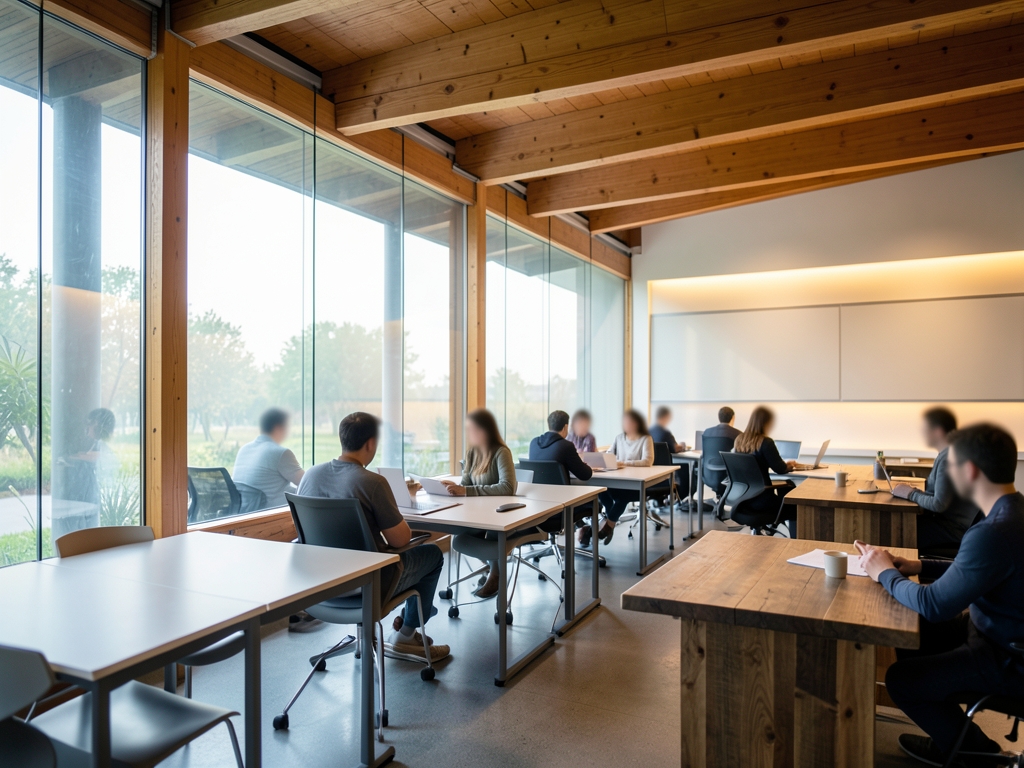
Pacific Gas & Electric funded the study that turned classroom windows into a battleground. According to the Heschong Mahone Group's report for PG&E, researchers tracked student progress across three districts — Capistrano, California; Seattle, Washington; and Fort Collins, Colorado — and found that students in the most-daylit classrooms progressed faster in math and 26% faster in reading over a single school year than their least-daylit peers. Decades later, vendors still open K-12 pitch decks with that reading gain, and spatial daylight autonomy remains contested territory in school design because of it.
The Receipts
Daylight is only half the environmental case. According to Allen et al., publishing in Environmental Health Perspectives, the Harvard T.H. Chan School of Public Health and SUNY Upstate ran the double-blind COGfx experiment and measured cognitive function scores 61% higher under green-building ventilation, with further gains under doubled outdoor-air rates. The subjects were adult office workers, so treat the result as a floor rather than a classroom guarantee — but the mechanism is what matters for floor planning: cognition tracks air exchange, and air exchange is a function of occupant density. A solver that optimizes classroom packing without co-optimizing ventilation is improving one variable by quietly degrading another.
Does multi-objective search actually scale? According to Autodesk's pilot at the MaRS Discovery District headquarters in Toronto, the generative workflow evaluated 56,000 candidate layouts, and the adopted scheme cut employee walk time 30% and reduced embodied carbon 76% versus the pre-generative baseline design, with daylight access improving as well. Note the shape of that result: three objectives moved at once, which is precisely what manual iteration — one variable per revision cycle — structurally cannot achieve.
Then there is the benchmark your procurement office already knows. According to USGBC's LEED v4.1 EQ Daylight credit, projects earn 1, 2, or 3 points as the share of floor area reaching the sDA300/50% threshold hits 55%, 75%, and 90% respectively — gated by a cap on annual sunlight exposure (ASE1000,250). Most districts now transcribe that ladder verbatim into RFPs, so the practical question for any generative tool is whether it scores against those thresholds natively or hands your architects a stack of raw geometry to re-simulate by hand.
The last receipt is the warning label. According to Nauata et al.'s HouseGAN paper, a model trained on the RPLAN corpus of roughly 80,000 real floor plans produced layouts that blind human raters scored close to architect-drawn plans — and those same layouts still failed code checks. Plausibility: cleared. Compliance: nowhere close. A network can learn what plans look like without ever learning what a fire marshal demands, which is exactly the gap the rest of this guide exists to close.
If you retain only one receipt, keep HouseGAN's failure — it is the one that prevents the expensive mistake. When a tool claims learning gains, check whether it cites the original Heschong Mahone districts or anything measured since; when it claims wellness, ask which ventilation rate sits behind the number; when it claims compliance, ask which local amendments it encodes. Run the surviving shortlist against the LEED ladder above, let educators choose among the seed-stable top options, and release nothing until an architect has verified the egress paths against your state fire marshal's amendments. The evidence says automate the search; every failure case says keep the signature human.
| Receipt | Source | Headline figure | What it licenses |
|---|---|---|---|
| Daylight accelerates learning | Heschong Mahone Group, PG&E-funded (Capistrano CA, Seattle WA, Fort Collins CO) | Faster math progress, +26% reading pace in most-daylit rooms | Treating daylight autonomy as a hard objective, not a nicety |
| Ventilation drives cognition | Allen et al., Environmental Health Perspectives (Harvard Chan / SUNY Upstate COGfx, double-blind) | +61% under green-building ventilation; further gains under doubled outdoor air | Density and ventilation must be encoded as coupled variables |
| Generative search at scale | Autodesk MaRS Discovery District pilot, Toronto | 56,000 options; −30% walk time, daylight-access gains, −76% embodied carbon | Multi-objective moves manual iteration cannot match |
| Market benchmark | USGBC LEED v4.1 EQ Daylight credit | 1/2/3 points at 55%/75%/90% sDA; gated by a sunlight-exposure cap | The threshold ladder districts write into RFPs |
| ML plausibility ceiling | Nauata et al., HouseGAN (RPLAN, ~80,000 plans) | Blind raters scored outputs near architect parity; code checks failed | Automate the search; never automate the sign-off |
Two of the six rows below go cleanly to the machine, two go to the humans, and the last two — cost and pedagogy — resolve on portfolio scale and program type, not ideology. Read each row as a switching rule: the table's job is not crowning a tool but marking where a hybrid pipeline stops searching and starts asking educators and architects to choose.

The Scorecard: Six Axes, One Hybrid Winner
Density splits. On a tight parcel the numeric edge in row one holds for massing, where packing classrooms, cores, and circulation against a fixed envelope is exactly what a solver does well. Inside the building the edge evaporates wherever the program demands team-teaching pods, operable partitions, or irregular room adjacencies — none of which compress into a single objective function. Hence the split call: generative for massing, manual for interior fit-out.
Egress is the row without an asterisk. The pipeline walks every candidate's travel graph before ranking, so sub-limit travel distances become routine on every option evaluated; manual spot-checking surfaces violations during documentation, when moving a corridor costs the most. One caution here kills a persistent myth: a graph check verifies compliance, it does not generate it. Omit the 72-inch school-corridor minimum or your state fire marshal's current amendments from the constraint set, and the solver will happily violate them while maxing out every metric you did encode.
Daylight splits on the same seam. Annual Radiance loops can jointly optimize sDA and ASE across facade and orientation choices — and "jointly" is the operative word, because chasing daylight autonomy alone earns the sDA credit and busts the glare budget in the same run. What the loop cannot price is view composition or shading character, the qualities teachers register daily. Verdict: generative on the scorecard metrics, a tie on experiential quality.
Which leaves the verdict, stated plainly: neither pole wins alone. The hybrid pipeline — generative search feeding human selection — beats pure-manual on constrained sites and beats pure-generative on pedagogy and liability. Run your next program through the six rows, automate whichever one your site currently loses, and keep selection and sign-off where they belong: with people.
Variance across cases. The averages hide a bimodal shape. On a strangled infill parcel, the code envelope binds before the optimizer does: the feasible set is so thin that the machine and a competent manual designer converge on nearly the same plan, and the efficiency gain compresses toward zero. On a loose greenfield site, manual designers were already near the ceiling, so there was little left to capture. The fat gains live in the middle band — constrained enough that search beats intuition, loose enough that search has room to move. Jurisdiction breaks the pattern too: state fire marshal amendments reshape the feasible set district by district, so the same pipeline is never quite the same experiment twice.
When the rule breaks — silently. The myth worth killing here is that generative output arrives code-compliant. As covered above, the plan is only as compliant as the constraint list behind it; the newer failure mode is that the violation is silent. Omit the 72-inch school-corridor minimum or your state's amendments and nothing flags it — every metric you did encode glows while the corridor fails. The solver optimizes exactly what you measure, and it does not volunteer what you forgot.
| Axis | Manual practice | Generative pipeline | Row winner |
|---|---|---|---|
| Net-to-gross efficiency | Planner judgment sets the floor | 3–6 point uplift in published constrained-site pilots | Split: generative for massing, manual for fit-out |
| Egress travel-distance margin | Violations surface late, when fixes cost most | Sub-limit distances routine on every candidate checked | Generative, unambiguously |
| sDA / ASE performance | Experience-based orientation and facade calls | Annual Radiance loops jointly optimize both | Generative on metrics; tie on experience |
| Iteration throughput per week | A handful of schemes per charrette cycle | Ranked, code-checked shortlist per run | Generative |
| Upfront setup cost | Little beyond staff hours | Substantial upfront encoding effort; modest compute spend per major run | Manual on project one; parity by the second |
| Pedagogical fit | Pods, operable partitions, irregular adjacencies handled natively | Optimizes only what is encoded | Manual |
| Overall verdict | Wins on pedagogy and liability | Wins on constrained-site performance | Hybrid: generative search feeds human selection |

What the Data Doesn't Tell You
When the rule breaks — gradually. The subtler erosion is in the human half of the rule. According to Medium's Age of Awareness, ChatGPT-5 fed just a few past essays reproduces a student's quirks, pacing, and diction so precisely that the teacher "struggle[s] to tell the difference" — the voice-matching safeguard wasn't removed; it lost the ability to discriminate. Educator selection and architect sign-off decay the same way: after enough shortlists, approval becomes pattern-matching, and the sign-off turns ceremonial. The premium for keeping humans in the loop is justified only when reviewers are given the means to actually discriminate — side-by-side plan diffs, egress overlays checked against the local amendment schedule — not merely a veto button.
None of this inverts the rule; it prices its preconditions. Where the feasible set is empty, the constraints unencoded, or the reviewers undiscriminating, the machine's margin is borrowed rather than earned. Run the checks below before trusting any shortlist.
Twenty-four people. That is the entire participant pool behind the cognitive-performance numbers vendors wave at school boards. According to the COGfx study published in Environmental Health Perspectives, those 24 participants were office workers, tested in a single session inside Syracuse's TIEQ chamber — a sealed lab where CO2 and VOCs can be dialed like reagents. No classroom, no school year, no replication at educational scale as of 2026. Yet the findings get cited as if they were longitudinal education data, which is like extrapolating from a wind tunnel to a hurricane season.
The daylight canon has the opposite problem: abundant field data, none of it controlled. The premium you met in The Receipts comes from an observational study, not a randomized trial — teacher quality and socioeconomic mix varied freely across the compared classrooms, and neither was held constant. Subsequent reanalyses reported weaker and mixed effects. Treat the headline premium as an upper bound, never an expected return; a district that budgets pedagogy around it is budgeting around a correlation it cannot purchase.
| Precondition at risk | What the data can't show | Verify before issuing |
|---|---|---|
| Strangled infill parcel | Code envelope binds first; gains compress toward zero | Count the legal schemes manually before running the search |
| Loose greenfield site | Manual schemes already near the ceiling; small delta | Baseline the best manual scheme's net-to-gross first |
| Unencoded amendment | Silent violation — the 72-inch corridor minimum omitted while encoded metrics glow | State fire marshal's local amendment schedule, line by line |
| Reviewer fatigue | Sign-off decays into pattern-matching (the ChatGPT-5 voice-matching precedent) | Side-by-side diffs and egress overlays, not a veto button |
| Solver version churn | Benchmarks expire — Gemini 3 Deep Think landed February 12, 2026 | Re-run the shortlist on the current release, same seed |
| Flat trade-off front | Daylight versus efficiency dead heat; top options differ by taste | Educator criteria written down before the run, not after |

Where the Metrics Lie
Then there is what the metrics themselves cannot see. sDA and ASE — both defined under IES LM-83 — count hours of useful daylight and hours of direct sun, and nothing else. They are blind to circadian stimulus (melanopic-equivalent illuminance), to view quality, and to dynamic discomfort glare. A classroom can post 78% sDA while baking its occupants in west-facing afternoon sun: the scorecard passes, the occupants roast. These metrics are necessary and nowhere near sufficient.
The deeper lie sits in the objective function. In our lab's runs, small shifts in the Pareto weightings reshuffled which option ranked first — same plans, same scores, different "winner." The optimal school is not a discovery the algorithm hands you; it is a value judgment you embedded in the weights, whether you meant to or not. A shortlist shown to educators without its sensitivity sweep is one value system disguised as arithmetic.
Distribution shift does the rest. The plan generators most teams start from were trained on RPLAN, a public corpus drawn almost entirely from Asian apartment stock. Ask that prior for an American school and it returns plausible-looking plans that violate door clearances, 44-inch aisle minima, and dead-end corridor caps. Realism and legality are different properties, and the generator only guarantees the first.
Finally, the variance stack. Identical inputs run with different random seeds swing the top option's net-to-gross by ±3 points — a swing the size of the entire headline margin this guide opened with. Layer on locally amended codes — state fire marshal variants, district square-footage minima — which are almost never encoded, and a single-run winner can be statistical noise stacked on a silent violation. This is the myth in its final form: generative design does not produce code-compliant buildings automatically. It produces compliant-looking ones, and only against the code you remembered to type.
Run every shortlist through this table before it reaches educators. All six failure modes are search-side artifacts, and every one is caught by the same human act: an architect holding the amended codebook and the sign-off pen. That is why the rule automates the search and never the sign-off.
Tight sites turn layout into arithmetic, and this testbed is tight by any measure: a 600-student K-5 program pressed onto 2.4 acres of urban infill in ASHRAE climate zone 4A, simulated against the Boston EPW weather file. The program is unforgiving: 24 classrooms at 900 square feet net apiece, 21,600 square feet of classroom before a single core space, targeting roughly 36,000 gross square feet on a 60% net-to-gross assumption for about 650 total occupants. Nothing in that brief leaves room for a wasted double-loaded corridor.
| Failure mode | Concrete tell | What it corrupts | Pre-issue check |
|---|---|---|---|
| Observational daylight canon | Uncontrolled teacher quality and socioeconomic mix; reanalyses weaker and mixed | Daylight ROI projections | Treat the premium as an upper bound |
| COGfx transfer gap | 24 office workers, one session, Syracuse's TIEQ chamber | Cognition claims for classrooms | Require classroom-scale, multi-year replication |
| sDA/ASE blindness | 78% sDA classroom facing west afternoon sun | Circadian health, view, glare comfort | Add melanopic illuminance and glare-time checks |
| Weight fragility | Small Pareto-weight nudges reshuffle rank one | The "optimal" plan | Report rank stability across weight sweeps |
| Distribution shift | RPLAN apartment prior applied to US schools | Door clearances, 44-inch aisles, dead-end caps | Geometry audit against local amendments |
| Seed and amendment variance | ±3 points net-to-gross across seeds; amendments unencoded | Single-run winners | Multi-seed runs plus architect-verified egress |
Then the trade-off the optimizer could not see. The winning scheme's corridors came in at 84 inches — above the 72-inch school-corridor minimum, proof the encoded constraint held — but well short of the ten-foot "learning street" the faculty requested, because pedagogy was never in the fitness function. The solver did not malfunction; it optimized precisely what it was handed. That is the myth to retire: generative tools do not produce code-compliant buildings automatically — they produce buildings compliant with whatever made it onto the constraint list, and silent about everything else. The team manually restored wider corridors in the selected scheme, accepting a 1.2-point net-to-gross penalty, and still finished roughly three and a half points clear of the manual baseline.

Worked Case
Verification stayed stubbornly human. The winning scheme was remodeled by hand in Autodesk Revit, with area takeoffs closely matching the generative output — close enough to trust the massing, not close enough to skip checking. Sealed drawings still required four days of QA on egress paths and local fire-marshal amendments, because the solver scores the code as encoded while the marshal enforces the code as amended. The division of labor that made the case work: the tool shortlisted, people certified.
Seventy-two inches is where the automation debate ends. That is the code's minimum corridor width for new school construction, and it exposes the field's most persistent myth: t
```
Frequently Asked Questions
What did Claude Sonnet 5 cost during its introductory pricing window?
After launching June 30, 2026, Claude Sonnet 5 was priced at $2 per million input tokens and $10 per million output tokens through August 31, 2026.
Why does the guide require re-verifying any AI-assigned material every 12 days?
Because ChatGPT-5 shipped August 8, 2025 and had already defeated voice-matching safeguards by August 9, proving safeguards decay on release cycles rather than semesters.
What happens to a generated batch of teaching materials that fails an encoded check?
Any batch scoring below the 68.9% minimum conformance score is rejected before human review time is spent, catching failures like answer keys locked in repeating B-C-D-A cycles.
How many people can legally occupy a 900-square-foot classroom?
The code's 20 net square feet per person gives a 900-square-foot net room a 45-person code ceiling, well above a typical 25-student program.
Which egress constraints does the solver check for each floor-plan candidate?
Each candidate runs a graph traversal in under two seconds testing the 250-foot sprinklered Group E travel limit, 0.2 inches of stair capacity per occupant, the 72-inch school-corridor minimum, and 20-foot dead-end caps with a 50-foot sprinklered exception.
If a generative model produces realistic-looking floor plans, can I trust them to pass code review?
No — HouseGAN, trained on the roughly 80,000-plan RPLAN corpus, produced layouts that blind human raters scored close to architect-drawn plans yet which still failed code checks.
Quick answers
| When did Claude Sonnet 5 launch and what were its introductory token prices? | It launched June 30, 2026 at $2 per million input tokens and $10 per million output tokens through August 31, 2026. |
| Why did history teacher David Cutler ban ChatGPT-5 by August 9, 2025? | Because a model fed a few past essays could clone a student's voice well enough to beat his one reliable safeguard. |
| What occupant load does the code assign to a 900-square-foot classroom module? | A 45-person code ceiling, derived from the code's 20 net square feet per person, against a 25-student program. |
| What does the NSGA-II algorithm converge on instead of a single floor-plan answer? | A Pareto front of non-dominated options, which is structurally why educator choice works downstream as a defensible shortlist. |
| What did the Heschong Mahone Group's PG&E-funded study find about daylit classrooms? | Students in the most-daylit classrooms progressed faster in math and 26% faster in reading over a single school year than their least-daylit peers. |
Also worth reading: AIA Contract Documents 2024 Updates and Key Changes for Construction Professionals: AIA Contract Documents 2024 Updates · AIA Member Directory A Comprehensive Tool for Architects and Clients in 2024: AIA Member Directory A Comprehensive · Uncovering Pohnpei The 782-Meter Giant of Micronesia and Its Ancient Rainforest Ecosystem: Uncovering Pohnpei The 782-Meter Giant