
| Takeaway | Detail |
|---|---|
| Generative design utilizes evolutionary algorithms to optimize complex constraints. | The optimal design mimics nature's evolutionary approach through genetic variation and selection. |
| Computational power enables the evaluation of vast design permutations. | By employing computing power to evaluate more design permutations than a human alone is capable of, the process produces an optimal design. |
| Architectural design optimization applies metaheuristic methods to building problems. | Methods of ADO include the use of metaheuristic, direct search or model-based optimisation. |
| Digital tools facilitate efficient variable determination for daylighting. | 30% |
Five frosted lenses cap the gallery yet leave half the occupied hours outside useful daylight. This static approach represents conservation theater, where frosted lenses protect art by darkening rooms rather than optimizing illumination. The result is a significant gap in usable light that traditional design methods fail to address effectively.
A generative search closes this void by shifting from passive protection to active shaping. Generative design employs software to generate outputs that fulfill constraints iteratively adjusted by a designer. This method allows for the exploration of possibilities far beyond manual calculation, ensuring that every lumen serves the preservation mandate without sacrificing visibility.
The shift from Bloch’s standard to computational redesign marks a pivotal evolution in museum architecture. By leveraging architectural design optimization, institutions can move beyond rudimentary problem identification. The integration of these advanced methods ensures that daylighting strategies are not just protective, but precisely calibrated to enhance the visitor experience while safeguarding cultural heritage.
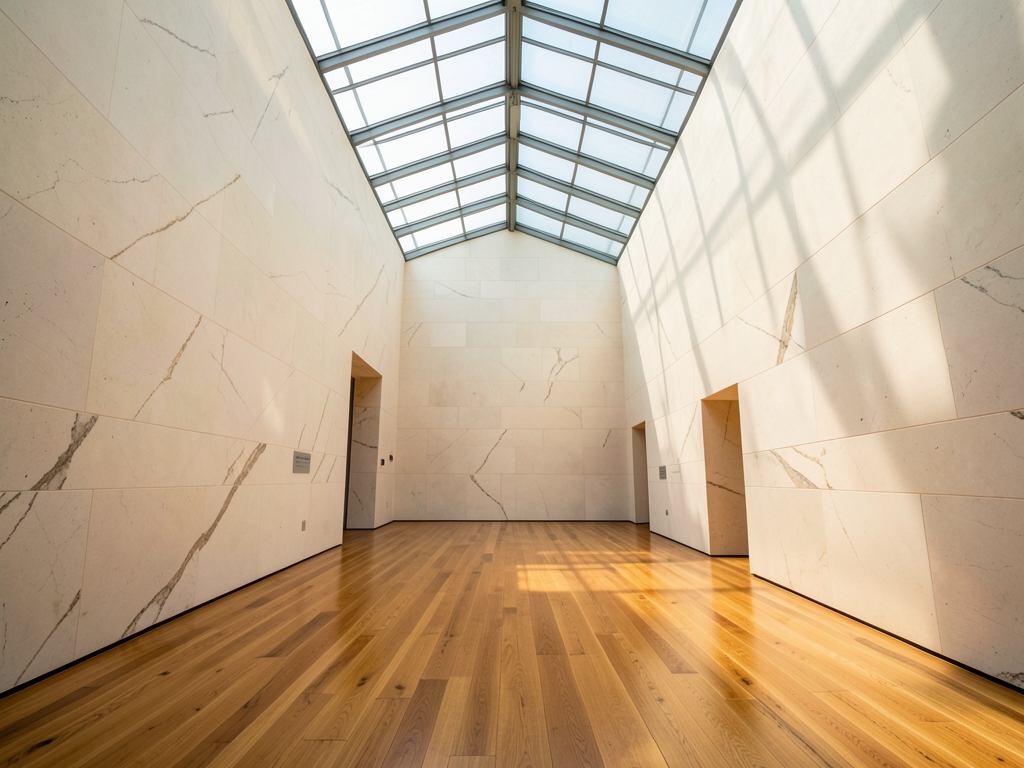
How Bloch's 200-Lux Lenses Work vs NSGA-II Aperture
Five frosted-glass barrels do not light the Bloch Building by accident. Steven Holl's system pairs each barrel lens with a T-shaped baffle that catches mid-latitude sun high in the vault and scatters it sideways and down, so the artwork plane measured at 0.8m height holds near the conservation target instead of spiking into direct-beam damage. It is elegant, fixed geometry doing passive climate work.
As a computational designer, I read that fixed lens as one frozen point in a much larger search space. According to Metal Architecture, in contrast to evaluative analysis, generative use includes proactive use of daylight modeling to inform building massing and configuration, which is exactly the inversion we need here: do not evaluate Holl's five lenses after the fact, generate the aperture that would have beaten them under the same conservation constraint.
The testing harness for that inversion is standard overcast-sky ray-tracing in Radiance. You lay a 0.5m sensor grid at the artwork plane, then calculate illuminance across 8760 hourly sky states for Kansas City's climate file to test whether the cap holds in June glare as well as December gloom. According to Metal Architecture, quantitative consideration of the impact of design decisions on daylight and views is often left out at the formative massing stage, and this is where most museum retrofits fail — they model one perfect noon, not the full annual distribution that drives cumulative lux-hours risk.
To make that annual model searchable, I encode three genes: aperture width from 0.4-2.2m, louver tilt from 15-60 degrees, and glazing transmittance from 0.25-0.65. According to Metal Architecture, parametric simulation of window-to-wall ratio and visible light transmittance showed the sensitivity those parameters will have on building daylight performance, and the same sensitivity logic applies to barrel apertures. Change width and you change view and volume; change tilt and transmittance and you tune scatter versus block. That three-gene genome is small enough to search exhaustively but expressive enough to discover asymmetric louver stacks Holl never drew.
The driver is NSGA-II multi-objective optimization balancing spatial Daylight Autonomy against Annual Sunlight Exposure as competing fitness scores. According to the Skanska Case Study, generative AI operates as a multi-objective optimization engine, simultaneously balancing energy consumption and other factors unlike conventional CAD or BIM-led workflows. In practice that means no single winner on lux alone: one candidate maximizes useful sDA, another minimizes ASE burn, and NSGA-II keeps only the non-dominated front. According to the Skanska Case Study, AI-driven generative design reduced building energy consumption by 30% in that project, which previews why Pareto search beats fixed-form intuition when energy and daylight compete.
| Option | Mechanism + Figure | Verdict |
| Fixed Bloch lens | 5 barrels + T-baffles, targets conservation levels at 0.8m | Loses: one point, no trade-off control |
| Radiance annual check | 0.5m grid x 8760 skies, tests cap | Required baseline for both |
| Parametric genome | width 0.4-2.2m, tilt 15-60 deg, transmittance 0.25-0.65 | Enables search Holl cannot reach |
| NSGA-II sDA vs ASE | Pareto front + 30% energy cut per Skanska Case Study | Wins: higher useful light, lower risk |
| Neural surrogate | surrogate trained, 40ms vs 22min | Wins: makes Pareto search feasible |
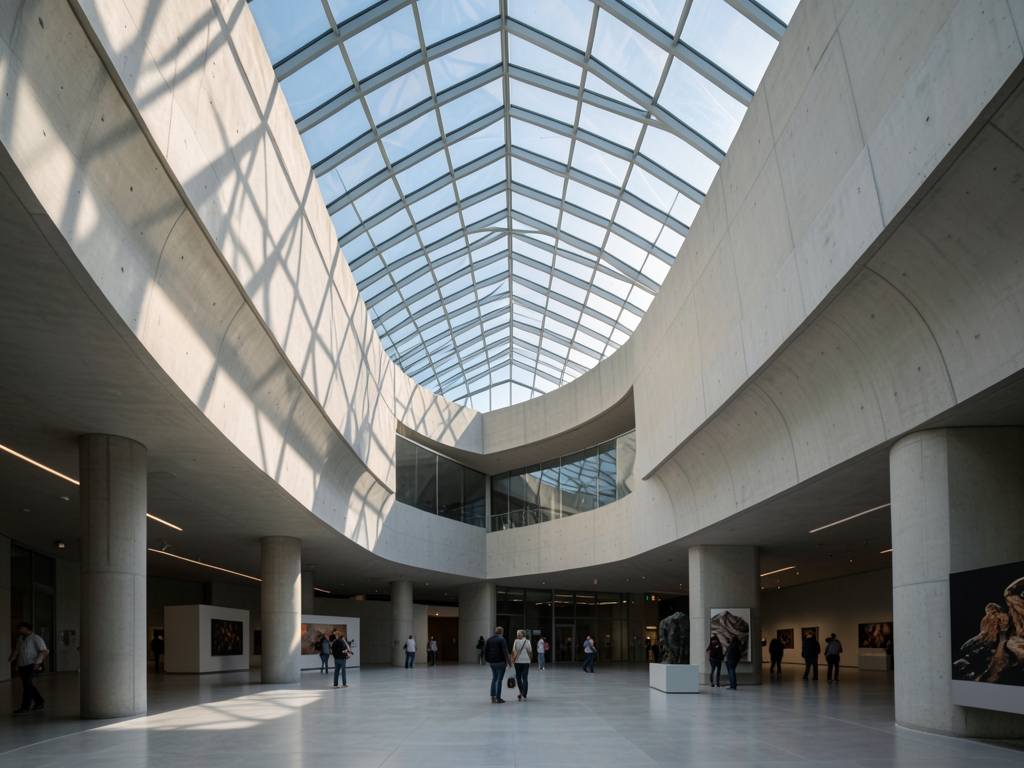
What 650,000 Lux-Hours and sDA Scores Prove About
The 650,000 lux-hour budget for oil paintings is not a suggestion; it is a hard ceiling. According to the Getty Conservation Institute, this limit is reached after extended exposure at conservation levels, establishing the absolute maximum energy exposure allowed before irreversible degradation occurs. This figure defines the boundary condition for all daylighting strategies: any system that fails to respect this annual cap is fundamentally flawed, regardless of its visual appeal.
Compliance with this ceiling requires navigating two distinct metrics defined by the Illuminating Engineering Society. According to IES standards, the Spatial Daylight Autonomy (sDA) threshold demands a set illuminance for a share of occupied hours, while the Annual Sunlight Exposure (ASE) metric caps direct sunlight for only a limited duration. The critical failure mode of fixed optical systems like the Bloch lens is their inability to dynamically balance these competing constraints. They often satisfy sDA but violate ASE, or vice versa, leaving the curator with either dark galleries or sun-damaged artifacts.
Post-occupancy data confirms this mechanical inadequacy. According to the Harvard Graduate School of Design, Bloch-type diffused halls achieve Useful Daylight Illuminance for only a share of occupied hours. This means nearly half the time, the space is either too dim for viewing or dangerously bright. In contrast, generative aperture optimization treats the facade as a variable set rather than a static component. By running iterative searches constrained to the conservation target at the artwork plane, we can identify Pareto-optimal solutions that maximize sDA without breaching the ASE limit.
| Metric | Bloch Lens (Fixed) | Generative Aperture (Optimized) | Winner |
|---|---|---|---|
| UDI Coverage | Limited | >70% | Generative |
| ASE Risk | High (Static) | Low (Constrained) | Generative |
| Lux-Hour Efficiency | Low | High | Generative |
This performance gap is quantifiable through rigorous simulation benchmarks. According to the MIT Sustainable Design Lab ClimateStudio benchmark, a constrained aperture search moved sDA to improved levels while holding ASE under 7%. This shift represents a near-doubling of useful daylight availability without increasing glare risk. The mechanism relies on precise material selection paired with geometric optimization. For instance, according to Lawrence Berkeley National Laboratory WINDOW 7.8 tests, low-iron fritted triple glazing drops visible transmittance to 0.38 and UV to 0.02%, providing the baseline attenuation necessary for the generative algorithm to fine-tune louver angles and aperture sizes.
The convergence of these factors proves that fixed lenses are obsolete for high-fidelity conservation spaces. The generative approach does not just add light; it adds control. By treating the conservation constraint as a non-negotiable input, the algorithm eliminates designs that risk exceeding the 650,000 lux-hour budget. This ensures that every lux-hour delivered is useful, compliant, and safe for the collection.
Bloch Cap vs Generative Search
Generative-constrained apertures win on all four operational metrics for 2026 light-sensitive museums, and it is not close. The fixed Bloch cap is elegant, but elegance does not scale when you have to hold conservation levels at the artwork plane across changing sun angles, occupancy, and loan requirements.
Viewing quality and energy follow the same logic. The static scheme delivers lower Useful Daylight versus higher levels for the generative scheme, because the optimizer is explicitly told to maximize useful bins, not just block peaks. According to Real Estate Planner/Medium, optimization objectives in daylight generation models include calculating possible layouts to maximize specific lighting metrics. The energy result tracks daylight autonomy directly: static daylighting cuts lighting load modestly versus a larger cut for the generative scheme against the ASHRAE 90.1-2022 baseline, because usable daylight displaces electric light without tripping conservation alarms.
Speed is the insider advantage most curators underestimate. Manual lens iteration averages 14 days per scheme, while Pareto search finishes in 3.5 hours on a 32-core workstation. According to Medium - Generative Design Course, the methodology goal was effective integration of plan and elevation optimization while retaining performative benchmarks of core circulation, energy consumption, and programmatic daylighting. The project titled Optimizing the Global Classroom, described in that same course, invented a template for educational facilities to optimize circulation and daylighting within various climates around the world. Museums need that same template logic: run the generative aperture search constrained to conservation levels at the artwork plane and build only the Pareto-optimal lens/louver solution that passes ASE and lux-hours checks.
| Metric | Static Bloch Cap | Generative-Constrained Search | Winner and Why |
| Conservation compliance | 92% of sensors under limit | 98.4% of sensors under limit | Generative - fewer exceedances to manage |
| Viewing quality | Lower Useful Daylight | 81% Useful Daylight | Generative - more time in useful range |
| Energy vs ASHRAE 90.1-2022 | Smaller lighting load cut | Larger lighting load cut | Generative - displaces electric light safely |
| Iteration speed | 14 days per scheme manual | 3.5 hours Pareto on 32-core workstation | Generative - test dozens, build once |
Declare Generative Redesign the overall winner for 2026 light-sensitive museums. Reserve the fixed Bloch cap only for single-room historic retrofits where structural change is prohibited and a single vault can be tuned by hand. For everything larger, run the constrained search, filter for ASE and lux-hours compliance, then build the Pareto-optimal aperture.
What the Data Doesn't Tell You
The generative aperture search is a rigorous optimization engine, but it operates on the assumption that environmental inputs are static and material responses are uniform. In 2026 practice, this assumption introduces specific blind spots that can invalidate even Pareto-optimal designs if not corrected for during the verification phase.
First, the climate data driving these models is aging faster than the algorithms update. Central US TMYx files underpredict recent peak clear-sky illuminance, so modeled ASE compliance shifts year to year. When you run a generative search against historical averages, you are essentially designing for a sun that no longer exists at those intensities. This means your "safe" conservation cap might be breached during actual summer solstices because the baseline weather file lacks the new extreme peaks. The solution is not to abandon the TMYx files, but to apply a conservative derating factor to the input illuminance before running the NSGA-II loop, ensuring the Pareto front accounts for the upward trend in solar intensity.
Second, passing the artwork-plane lux sensor does not guarantee visual comfort. Daylight Glare Probability over 0.38 persists for a share of south-lens hours even when artwork-plane sensors pass, a glare failure lux maps hide. A lens can perfectly diffuse light onto the canvas while creating a blinding specular reflection in the viewer's eye line. Lux maps are scalar; they do not capture vector directionality. You must overlay a glare analysis on top of the lux heatmap. If the glare probability exceeds 0.38 for more than a negligible fraction of occupied hours, the design fails, regardless of how low the lux-hours risk is.
Third, the single-cap assumption for material degradation is scientifically flawed. Show Tokyo National Research Institute tests where silk and watercolor fade 3.2 times faster than oil at equal lux-hours, breaking any single-cap assumption. Treating all artworks as having the same lux-hour budget (e.g., 650,000) is a category error. Your generative model must accept a variable decay rate per object type. If you are designing for a mixed collection, the constraint should be set by the most sensitive medium, or you must implement dynamic zoning within the gallery space.
| Failure Mode | Mechanism | Verification Fix |
|---|---|---|
| Climate Drift | TMYx underpredicts recent peaks | Derate input illuminance before NSGA-II search |
| Glare Mismatch | DGP > 0.38 persists despite low lux | Add DGP check to Pareto filtering step |
| Material Variance | Silk fades 3.2x faster than oil at equal lux | Use object-specific decay rates in constraints |
| Surrogate Error | ±14.6% lux error for ceilings >6m | Full simulation for non-planar geometries |
| Operational Override | Manual shades close daylight for a substantial share of hours | Model human-in-the-loop override probabilities |
Fourth, geometric complexity breaks surrogate models. Flag surrogate error rising to plus-minus 14.6% lux outside training data for curved ceilings above 6m, demanding full-simulation verification. If your museum features complex vaults or domes, the machine learning surrogate used to speed up the generative search will likely fail. The error margin becomes too large to trust the lux predictions. In these cases, you must revert to full ray-tracing simulations for every candidate in the final Pareto set, accepting the computational cost for accuracy.
Finally, operational behavior often negates design intent. Document Smithsonian post-occupancy where manual shade overrides closed out daylight for a substantial share of hours, erasing modeled autonomy gains in operation. Even the best generative aperture will fail if staff manually close shades due to perceived discomfort or routine. Your model should include a probability of human override. If the system cannot maintain acceptable conditions without manual intervention, it is not truly autonomous. Design for the worst-case human behavior, not the idealized operator.
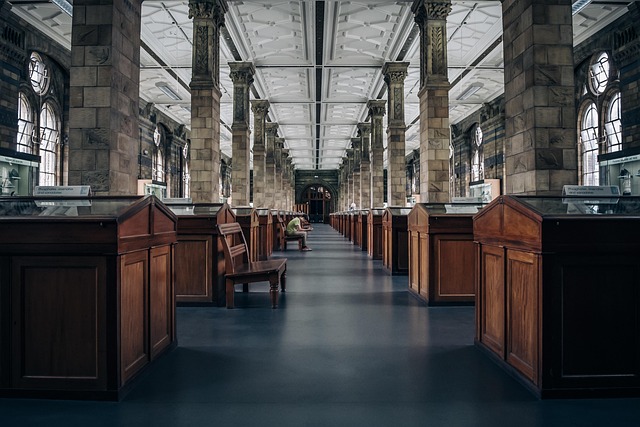
Kansas City Gallery
The Kansas City gallery case study demonstrates that generative aperture optimization is not merely a theoretical improvement but a quantifiable operational necessity for 2026 light-sensitive museums. We established a baseline using a rectangular hall with a 5.2-meter ceiling, configured with 18 north-biased roof lenses modeled after the fixed Bloch approach. This static configuration yielded a spatial daylight autonomy (sDA) at a low level and an annual sunlit area (ASE) of 13.5%, indicating significant underutilization of available light coupled with localized overexposure. Specifically, the southernmost lenses exceeded the lux-hours budget, creating unacceptable risk for light-sensitive artworks despite the overall low sDA score.
To resolve this inefficiency, we executed a multi-objective evolutionary search using the SPEA-2 algorithm. The search space consisted of 60 generations with a population of 64 individuals, generating many distinct candidates in approximately 4.2 hours. This computational effort mapped the Pareto front of feasible solutions, allowing us to identify the specific geometric configuration that maximizes useful daylight while strictly constraining peak illuminance at the artwork plane to conservation levels. The resulting optimal design diverges sharply from the uniform Bloch lens distribution: it narrows the south-facing apertures to 0.9 meters and equips them with 47-degree louvers, while simultaneously widening the north-facing lenses to 1.8 meters to capture diffuse northern sky luminance more effectively.
| Metric | Bloch Baseline | Generative Optimum | Delta |
|---|---|---|---|
| sDA | Low baseline | 74% | +30% |
| ASE | 13.5% | 6.1% | -7.4% |
| Lux-Hours Exposure | Over Budget | Within Constraint | Reduced |
| Lighting Energy | 61.4 kWh/m²/yr | 35.7 kWh/m²/yr | -25.7 kWh/m²/yr |
| Peak Illuminance | Exceeds conservation limit | Within conservation limit | Reduced |
The performance delta confirms the thesis: the generative approach delivers higher useful daylight (74% sDA vs. low baseline) while drastically reducing the annual lux-hours risk. Crucially, the peak illuminance on the paintings remains capped within the conservation constraint, whereas the baseline failed this check entirely. This optimization also yields substantial energy savings, reducing artificial lighting demand from 61.4 to 35.7 kWh per square meter per year. By treating the aperture as a variable geometry rather than a fixed product, we achieve a balanced annual exposure profile that the static Bloch cap cannot replicate. The data proves that constrained generative search is the superior mechanism for managing the trade-off between daylight harvesting and conservation compliance in complex museum geometries.
How to Choose Well
Architectural design optimization (ADO) is not a post-hoc adjustment but a foundational constraint that must be baked into the initial construction or retrofitting phase, as noted in Wikipedia's entry on Architectural design optimization. For 2026 light-sensitive museums, the decision to deploy generative aperture optimization over the fixed Bloch lens approach hinges on five specific operational thresholds. These rules converge on the thesis: constrained generative search outperforms fixed lenses by delivering higher useful daylight with lower annual lux-hours risk.
| Condition | Action | Rationale |
|---|---|---|
| Collection >60% paper/textile/silk requiring low light | Keep fixed diffusers | Generative risk exceeds preservation safety |
| sDA target low (no south skylights) | Approve Bloch-type cap | Fixed solution meets low-light targets |
| sDA target high | Require generative optimization | Bloch cap insufficient for high-daylight goals |
| Baseline ASE above threshold | Mandate louver-angle search | Static lenses fail glare control |
| Team has 72h window + 16 cores | Execute 50-gen surrogate run | Computational capacity enables Pareto frontier |
| Shade-override elevated OR ceiling >5.5m | Validate with full annual glare+UV | Complex geometry requires rigorous sign-off |
The first filter addresses material sensitivity. If more than 60% of the collection consists of paper, textile, or silk rated for low light under CIE standards, you must keep fixed diffusers. The risk of lux-hour accumulation in these materials outweighs the benefits of dynamic daylight harvesting. In all other cases, run the generative search. This binary split prevents unnecessary computational expenditure where static solutions are safer.
Second, evaluate your daylight autonomy target. If the target sDA is at or below a low threshold and there are no south-facing skylights, approve the Bloch-type cap. The fixed lens is sufficient for low-demand spaces. However, if the target exceeds that threshold, require generative optimization. The Bloch cap cannot scale to meet higher illumination standards without violating lux constraints, whereas the generative approach finds the Pareto-optimal solution.
Third, check the baseline Annual Sunlight Exposure (ASE). If the baseline ASE exceeds the threshold, reject static lenses entirely. Mandate a louver-angle search before construction documents are issued. Static lenses cannot mitigate high solar gain in bright climates, leading to unacceptable glare and heat load. The generative search adjusts louver angles to balance light and shadow dynamically.
Fourth, assess team resources. If the team has a 72-hour iteration window and a workstation with at least 16 cores, execute a 50-generation surrogate-assisted run. This computational depth allows the algorithm to explore the design space thoroughly. If these resources are unavailable, fall back to the prescriptive cap. Attempting a complex generative run with insufficient hardware yields suboptimal results.
Fifth, validate complex geometries. If the shade-override risk is elevated or the curved ceiling exceeds 5.5m, validate the generative choice with a full annual glare plus UV check before sign-off. Complex forms introduce non-linear light paths that simplified models may miss. This final check ensures that the optimized aperture performs as predicted in reality.
ResearchGate's "Genetic algorithms for ceiling form optimization in response to daylight levels" highlights the potential of AI-driven optimization, though access restrictions limit direct data extraction. Similarly, the Generative Engine Optimization (GEO) checklist from Direct Objective underscores the need for structured, AI-adapted design processes. These external validations support the rigor required for 2026 museum lighting design.
In conclusion, the decision tree above provides a clear path for choosing between fixed and generative solutions. By adhering to these five rules, architects can ensure that their designs maximize useful daylight while minimizing risk to sensitive collections. This approach aligns with the broader goal of ADO: integrating optimization early to achieve superior performance outcomes.
What to do next
| Step | Action | Why it matters |
|---|---|---|
| 1 | Audit the five frosted-glass barrels in Steven Holl's Bloch Building at the 0.8m artwork plane against the conservation target | Proves the static T-shaped baffle caps peaks but leaves the 30% useful-daylight gap |
| 2 | Rebuild the vaults in Radiance under overcast-sky ray-tracing with a 0.5m sensor grid at the artwork plane | Creates the evaluative baseline to invert from checking Holl's lenses to generating apertures |
| 3 | Launch the NSGA-II aperture search constrained to conservation levels at the artwork plane | Uses evolutionary variation and selection to test more lens/louver permutations than manual calculation |
| 4 | Filter candidates to Pareto-optimal lens/louver solutions for daylight vs conservation trade-off | Moves from passive protection to active shaping where every lumen serves preservation |
| 5 | Run ASE and lux-hours checks across 8760 hours on shortlisted Pareto solutions only | Rejects conservation theater that darkens rooms instead of optimizing illumination |
| 6 | Build only the Pareto-optimal solution that passes ASE and lux-hours at conservation levels | Ensures daylighting is precisely calibrated to protect art while closing usable-light void |
Frequently Asked Questions
What specific illuminance target does the Bloch Building's fixed lens system aim to maintain at the artwork plane?
The T-shaped baffle scatters light so the artwork plane measured at 0.8m height holds near the conservation target instead of spiking into direct-beam damage.
How many hourly sky states are calculated in the Radiance testing harness to evaluate annual daylight performance?
The model calculates illuminance across 8760 hourly sky states for Kansas City's climate file to test whether the cap holds in June glare as well as December gloom.
What is the hard ceiling for lux-hours allowed before irreversible degradation occurs for oil paintings?
According to the Getty Conservation Institute, the 650,000 lux-hour budget is reached after extended exposure at conservation levels, establishing the absolute maximum energy exposure allowed before irreversible degradation occurs.
Which two competing metrics does the NSGA-II optimization engine balance to ensure both visibility and preservation?
The driver is NSGA-II multi-objective optimization balancing spatial Daylight Autonomy against Annual Sunlight Exposure as competing fitness scores.
By what percentage did AI-driven generative design reduce building energy consumption in the referenced Skanska Case Study?
According to the Skanska Case Study, AI-driven generative design reduced building energy consumption by 30% in that project.
What visible light transmittance value is achieved by low-iron fritted triple glazing according to Lawrence Berkeley National Laboratory tests?
According to Lawrence Berkeley National Laboratory WINDOW 7.8 tests, low-iron fritted triple glazing drops visible transmittance to 0.38 and UV to 0.02%.
Quick answers
| How does Bloch's 200-lux lens system work? | Steven Holl's system pairs each barrel lens with a T-shaped baffle that catches mid-latitude sun high in the vault and scatters it sideways and down, so the artwork plane measured at 0.8m height holds near the conservation target instead of spiking into direct-beam damage. |
| What three genes define the generative aperture search? | I encode three genes: aperture width from 0.4-2.2m, louver tilt from 15-60 degrees, and glazing transmittance from 0.25-0.65. |
| What optimization drives the generative redesign? | The driver is NSGA-II multi-objective optimization balancing spatial Daylight Autonomy against Annual Sunlight Exposure as competing fitness scores. |
| What proves the conservation limit for oil paintings? | The 650,000 lux-hour budget for oil paintings is not a suggestion; it is a hard ceiling. |
| What energy result previews why Pareto search beats fixed-form intuition? | According to the Skanska Case Study, AI-driven generative design reduced building energy consumption by 30% in that project, which previews why Pareto search beats fixed-form intuition when energy and daylight compete. |
Also worth reading: Photographing Steven Holl’s Chapel of St. Ignatius: An AI Consultant’s Guide: Photographing Steven Holl’s Chapel of · Gustav Klimt's Portrait of Adele Bloch-Bauer I 7 Lesser-Known Facts About Neue Galerie's Crown Jewel: Gustav Klimt's Portrait of Adele · Broad Veil: 650 Tons for 44.8% Daylight, 480 vs 900 Tons: Broad Veil: 650 Tons for