
The Shanghai Tower twists because a project-specific wind tunnel test showed a 24% reduction in wind load, while a rectangular massing is more cost-effective when that reduction doesn't cover the added costs for steel, the building envelope, and construction.
As detailed in the sections below, the pass/fail rule is applied using the same height, GFA, and site before any massing is selected.

How a 120° twist reduces wind load
Model the tower as a tapered prism and test the mechanism directly: the helical twist and taper disrupt organized vortex shedding, so the key outcome to verify is a reduction in the across-wind base moment, not just lower along-wind pressure. IJERT’s Evaluation of Mean Wind Loads on Two Rectangular Building Models distinguishes between along-wind and across-wind forces; make sure this distinction is clearly reflected in the test program.
For this specific case, test the Shanghai Tower’s 120° helical twist together with its tapered profile. Treat the angle as a project-specific parameter, not a universal rule: a different height, floor plan, or terrain calls for a new wind tunnel test because the vortex shedding pattern depends on the overall geometry and exposure.
Keep the height, GFA, site, floor-area schedule, and reference wind climate the same across the rectangular, tapered-only, and twisted models. Use the same reference dynamic pressure and model scaling, and document any corrections rather than letting normalization mask a geometric difference. Vary the rotation per floor in the twisted series, and measure the across-wind base moment over the tested wind directions. Keep along-wUse wind force and surface-pressure maps as diagnostics, but do not treat them as a proxy for the across-wind result.
Require a Cp/Cf table organized by wind angle for the rectangular, tapered-only, and twisted options, all using the same floor-area schedule. Define Cp as the local pressure coefficient and Cf as the direction-specific force coefficient; state the reference dynamic pressure, reference area, and normalization used. Pair each coefficient with the measured base moment so the table shows whether changes in local pressure are reflected in lateral demand. Report both directional peaks and the values used for design, and identify any direction in which the twisted model requires a higher moment.
Conclude the test record by documenting the model scale, blockage treatment, wind profile, terrain and exposure, surrounding geometry, rotation schedule, taper, and scatter across repeat tests. Inspect moment histories or spectra for signs that organized shedding has been disrupted. The deliverable is a project-specific wind-load basis; an angle borrowed from another tower is not.
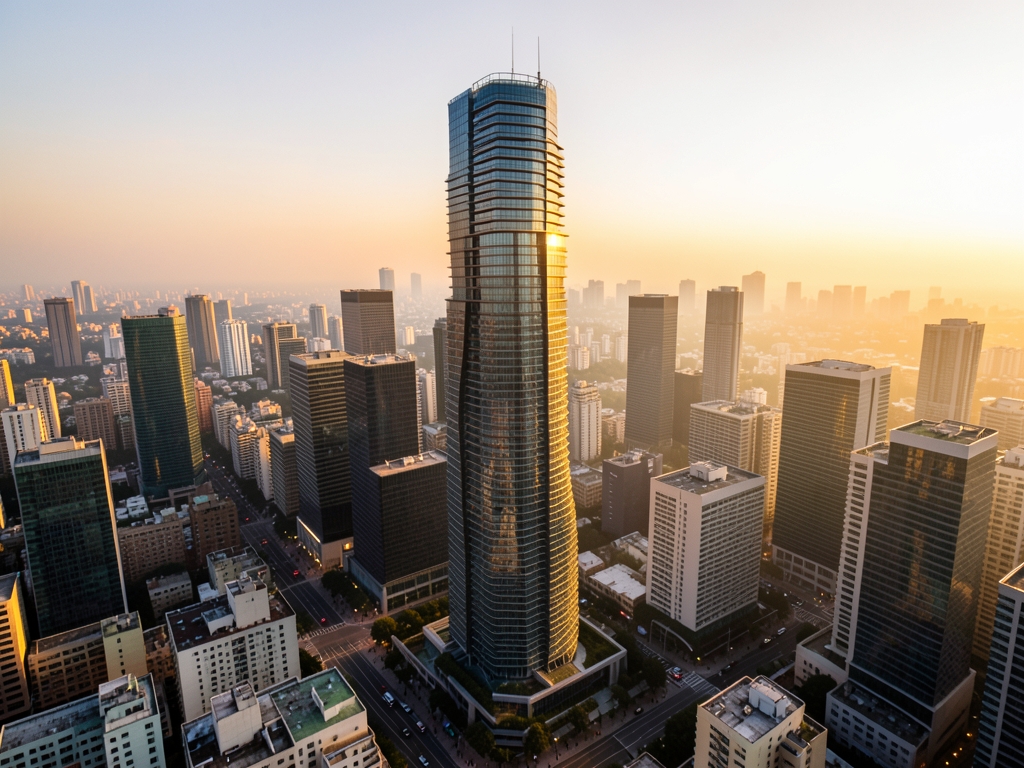
Evidence: One 24% Reduction, Not Three
The published 24% wind-load reduction should be treated as a single case-specific result, not a replicated benchmark. The key check is source pairing: two descriptions may refer to the same Shanghai Tower wind-tunnel program rather than to separate tests.
| Source or tool | What it supports | How to use it |
|---|---|---|
| Michael Z. Stern; EngineerHub | One 120° twisted case with a 24% wind-load reduction and wind-tunnel optimization | /td>Treat this as the same project, not an independent replication |
| Windy.app Shanghai spot | 6.6 m/s wind and 10.8 m/s gusts | Use for screening exposure only; never as tower-height design wind |
| IJERT rectangular models | Mean wind loads on rectangular buildings | Use as a baseline for comparison at the same height, GFA, and site |
| ASCE Hazard Tool | ASCE 7-10/16/20 wind parameters | Provides site-specific code inputs, not a benefit from twisting |
| SP 20.13330 calculator | Wind pressure by region, terrain, height, and surface | Use as another baseline or check, not as a twisted-tower result |
Michael Z. Stern reports that the 120° twist reduced wind load by 24%, while EngineerHub describes 120° twisting and tapered wind-tunnel optimization. These refer to the same case, not independent replications. If a proposal cites both, ask whether the second source adds new wind tunnel data or simply restates the same tower.
The Windy.app Shanghai spot shows 6.6 m/s winds and 10.8 m/s gusts. Use this only to screen for exposure, such as prevailing wind direction and gustiness relative to the site. It is not tower-height design wind; design wind must come from the applicable code or standard method for the building's height and terrain.
IJERT covers mean wind loads on rectangular building models, the ASCE Hazard Tool provides ASCE 7-10/16/20 wind parameters, and the SP 20.13330 calculator provides wind pressure by region, terrain, height, and surface. These establish the rectangular baseline and site parameters; they do not establish twist performance. Run rectangular and twisted schemes at identical height, GFA, and site, then compare verified present-value wind savings with the quoted ΔCapex plus Δmaintenance.
Adopt the twist only if a project-specific wind tunnel shows enough load reduction to make lifecycle savings exceed the incremental cost position; otherwise lock rectangular massing. The 24% figure is a published case value, not a default input for another site.

Twist vs rectangular: table winner
Run rectangular and twisted schemes at identical height, GFA, and site, then compare them on first cost and verified lifecycle payback. Rectangular massing is the default first-cost winner because no grounding cost figure shows that a twist pays back; a 120° twist becomes the lifecycle winner only when project quotes and project-specific tunnel data clear the decision gates set out in the decision-rules section below. If either is missing, lock rectangular massing.
| Option | First-cost rank | Wind-load evidence | Lifecycle winner |
|---|---|---|---|
| Rectangular massing | Lowest (default) | Baseline; no project-specific tunnel claim required | Yes, unless a twist clears the checkpoints |
| 120° twist | Higher (incremental) | Project-specific tunnel required; published case figure is not transferable | Only after verified PV wind savings exceed quoted ΔCapex plus Δmaintenance |
| Tapered twist + second skin | Highest (unquoted) | Second-skin contribution not separately proven by the available sources | No, until the second-skin contribution is tested |
The winner field is conditional, not aesthetic: rectangular wins first cost, and twist wins only on verified lifecycle payback. The twist row cannot be promoted on a published case figure alone; it needs its own tunnel result and its own cost quotes. Treat the published figure as a reason to test, not as a substitute for a project-specific result.
First-cost rank is not a design score; it only orders the options by quoted construction cost. A lower rank does not imply better wind performance, and a higher rank does not imply verified savings.
Reject the tapered-twist-plus-second-skin row as a proven alternative. None of the grounding material — the IJERT rectangular-model paper, the ASCE Hazard Tool, the SP 20.13330 calculator, or the Windy.app Shanghai spot — separately establishes the second skin's contribution, so a project-specific tunnel test isolating the second skin is required before adding its cost, detailing, and maintenance burden to the comparison. Until that test exists, keep it out of the winner field.
If the tunnel program or cost quotes are incomplete, the table’s default remains rectangular massing. That default protects the project from paying for an unverified aerodynamic benefit and keeps the comparison tied to quoted ΔCapex plus Δmaintenance.
Use the table as a gate: no row advances without evidence in its wind-load column, and no lifecycle winner is declared without both tunnel data and cost quotes.
Costs to quantify before choosing
Compare the two massings at identical height, gross floor area, and site conditions, then price the twist as an incremental-cost problem rather than as an aerodynamic benefit. The capital formula is ΔCapex = (twist steel + twist envelope + twist crane/erection + lost floor-area efficiency) − (rectangular equivalents). Each term must be a quoted, project-specific quantity, not an allowance carried from another tower.
The lifecycle formula is PV benefit = annual structural/material savings + verified HVAC/energy savings + rentable-area gain, discounted over the owner’s horizon, minus the twist maintenance and cleaning premium. “Verified” means measured or contractually guaranteed for this project; a published load reduction does not satisfy it.
A load percentage is not a cost percentage. Even a published 24% wind-load reduction describes force or moment behavior, not installed cost, and it does not by itself establish added steel tonnage, curved-envelope fabrication, crane time, or lost floor-area efficiency.
Pass/fail is strict: the twist passes only if PV benefit exceeds ΔCapex plus Δmaintenance. If any term in either formula is missing, unverified, or quoted as an allowance, mark the twist option unpriced rather than as a savings case, and do not treat it as the lower-cost scheme.
Before choosing, require a complete quote set for both massings: structural steel, envelope, erection, floor-efficiency loss, energy use, maintenance, and cleaning. Compare net present values on the same discount horizon and reject any comparison that changes height, GFA, or site assumptions between schemes.
| Decision item | Required expression or test |
|---|---|
| Incremental capital | ΔCapex = twist steel + twist envelope + twist crane/erection + lost floor-area efficiency − rectangular equivalents |
| Lifecycle benefit | PV benefit = annual structural/material savings + verified HVAC/energy savings + rentable-area gain − twist maintenance/cleaning premium, discounted over owner horizon |
| Adoption test | Twist passes only if PV benefit > ΔCapex + Δmaintenance; otherwise lock rectangular massing |
Where the 24% claim breaks
The table below defines the edge cases in which the published Shanghai Tower result must be set aside during early massing studies.
The published 24% wind-load reduction associated with Shanghai Tower is a project-specific wind-tunnel outcome, not a transferable credit for every twisted form. Apply it only when a new, project-specific wind tunnel confirms comparable conditions; otherwise the reduction should not be assumed in any comparison with a rectangular massing.| Edge case | Why the 24% does not transfer | Required check or action |
|---|---|---|
| Different twist angle | 120° is the only grounded angle tied to that published result; another twist angle changes aerodynamic behavior and is not interchangeable with a 24% credit. | Run a new parametric wind tunnel for the proposed angle and record the twist-only load delta before comparing to a rectangular massing. |
| Different exposure or height | A public spot forecast does not represent tower-height design wind for a tall form. For Shanghai, Windy.app presents spot-level wind and weather forecasts, not a substitute for structural design wind at height. | Use ASCE Hazard Tool for site structural wind parameters where applicable, or the applicable China code with the correct terrain category, and base design wind on that determination rather than a spot forecast. |
| Second skin included | If reported results bundle façade or other aerodynamic add-ons with twist, the credited reduction may not be twist alone. | Isolate the twist-only delta in the tunnel program so any rectangular-versus-twisted comparison uses a like-for-like aerodynamic change. |
For exposure and height, treat the decision as a sourcing step: identify the governing design wind path for the site and elevation, then test the proposed massing in that environment. A public spot forecast cannot replace code-based or hazard-tool-based design wind at supertall height, and terrain category choices can shift demands enough to invalidate a borrowed percentage. For example, Windy.app’s Shanghai spot forecast describes near-surface conditions for a location, while structural design requires elevation-appropriate wind criteria selected through recognized tools or codes.
When a scheme changes angle or adds a second skin, the only safe move is to rerun project-specific testing and report a twist-only delta. Without that isolation, any claimed savings against a rectangular massing are not supported by the Shanghai Tower reference case, because the reference does not certify a different geometry or a bundled envelope strategy. Document the test setup so reviewers can see whether twist alone was measured.
Worked worksheet and cost of error
This section is the copy-usable pass/fail worksheet and the two-sided cost-of-error check; use it before design development locks either option. Run the rectangular and twisted schemes at identical height, GFA, and site. A row without a named source file is not evidence; it is an assumption, and the decision stays with the rectangular scheme.
| Input | Source file name |
|---|---|
| Project height | [height schedule] |
| GFA | [area schedule] |
| Site category | [ASCE Hazard Tool export] |
| Rectangular Cp/Cf | [wind tunnel report] |
| Twist Cp/Cf | [wind tunnel report] |
| Across-wind base moment | [wind tunnel report] |
| Quoted ΔCapex | [cost estimate] |
| Δmaintenance | [maintenance estimate] |
| Annual savings | [savings model] |
| Discount rate | [owner economics memo] |
| Owner horizon | [owner brief] |
| Owner hurdle | [owner economics memo] |
| Erection weeks added | [method statement] |
| Schedule float | [baseline program] |
Fill every row from the named file; a blank source file name voids the row. IJERT’s rectangular-building wind-load paper treats wind action through pressure/force coefficients and along-/across-wind cases, so keep rectangular and twist Cp/Cf separate and directional. Use the ASCE Hazard Tool export for site category under the adopted ASCE 7 edition; if height, GFA, or site inputs differ between schemes, reset the worksheet.
Checkpoint 1: the tunnel must show an across-wind base moment reduction for the twist versus rectangular; if the reduction is zero or negative, stop and select rectangular. Checkpoint 2: calculate PV benefit from annual savings, discount rate, and owner horizon, then require PV benefit / ΔCapex ≥ owner hurdle; if no, select rectangular. Also apply the reader rule: PV benefit must exceed quoted ΔCapex plus PV of Δmaintenance; if it does not, select rectangular.
Checkpoint 3: erection weeks added must be ≤ schedule float; if no, re-sequence or reject the twist. A re-sequenced scheme is a new case: update the method statement, baseline program, cost estimate, and savings model files before it returns to Checkpoints 1 and 2. Recovered float is a benefit only if the baseline program file shows it.
For the error test, price both mistakes with the same inputs and horizon. Approving a twist that fails the net test leaves the owner with quoted ΔCapex plus PV of Δmaintenance that verified PV benefit does not cover; rejecting a twist that clears every gate forfeits the excess of verified PV benefit over that same cost base. If approval-side exposure is larger, demand more evidence before approval; if rejection-side opportunity is larger, re-open the twist only with complete tunnel, cost, and schedule files.
Decision rules for the twist
A twisted massing decision should be treated as a gated lifecycle test, not a geometric preference. The comparison is valid only when the rectangular and twisted schemes are modeled at identical height, gross floor area, and site, with wind inputs derived from the same project-specific basis. Site wind parameters from a recognized source such as the ASCE 7 Hazard Tool can establish the baseline design context, but the massing choice must still be resolved by project-specific wind-tunnel results and a lifecycle cost comparison. The five if/then rules below implement the canonical decision rule.
| Condition | Decision rule |
|---|---|
| The rectangular and twisted schemes are not tested at identical height, gross floor area, and site. | Treat the comparison as invalid; rerun the baseline before selecting a massing. |
| Wind-tunnel pressure or force coefficients (Cp/Cf) for the twist are not lower than the rectangular scheme at governing wind angles. | Select rectangular massing. |
| The measured wind-load reduction is not converted into verified present-value lifecycle savings. | Do not adopt the twist; complete the PV comparison against the rectangular baseline. |
| ΔCapex is unpriced or missing crane or envelope terms. | Do not claim rectangular wins; run a bid comparison first. |
| Verified PV wind savings clear ΔCapex plus Δmaintenance and schedule float holds. | Adopt the twist; otherwise lock rectangular massing. |
The first gate is aerodynamic validity. A project-specific wind tunnel must test both massings under the same governing wind angles and report comparable coefficients; if the twist does not reduce Cp/Cf where the rectangular scheme governs, no lifecycle calculation can justify the added geometric complexity. This check should be documented within the same test campaign, not inferred from another building or a generic benchmark.
The second gate is commercial completeness. A lower wind load does not automatically produce a winning scheme, and an incomplete cost package does not prove the rectangular option is cheaper. Before any claim is made, the team needs a bid-level comparison that prices the twist-specific scope and confirms whether the schedule still carries enough float to absorb its construction sequence. If those inputs are missing, the decision stays open until pricing is complete.
The final gate is the lifecycle test. Adopt the twist only when verified present-value wind savings exceed the quoted ΔCapex plus Δmaintenance and the schedule float holds; if either condition fails, lock rectangular massing. Apply the rules in sequence and record the pass/fail basis at each gate: the tunnel report supports the Cp/Cf comparison, the bid package supports cost completeness, and the present-value model supports the savings-versus-cost test. When any gate fails, the default action is to keep the rectangular massing rather than carry an unverified twist assumption into design development.
What to do next
| Step | Action | Why it matters |
|---|---|---|
| 1 | Fix the rectangular and twisted schemes at identical height, GFA, and site before comparing Shanghai Tower’s massing options. | Prevents scale or location differences from distorting the cost and wind-performance comparison. |
| 2 | Obtain project-specific wind-tunnel results for both schemes; treat the cited wind-load cut as evidence to verify, not a transferable assumption. | Ensures the wind case reflects the actual site and massing being priced. |
| 3 | Get quoted incremental steel, envelope, and construction costs for the twisted scheme versus the rectangular scheme, and record the total as ΔCapex. | Captures the full added capital cost of adopting the twist. |
| 4 | Quantify incremental maintenance for the twisted structure and envelope over the same lifecycle, and record it as Δmaintenance. | Prevents lower wind loads from obscuring higher ongoing costs. |
| 5 | Convert the verified wind-load reductions into present-value wind savings, then compare them with quoted ΔCapex plus Δmaintenance. | Tests lifecycle savings against the complete incremental cost on a consistent basis. |
| 6 | Adopt the twist only if verified PV wind savings exceed quoted ΔCapex plus Δmaintenance; otherwise lock rectangular massing as the cost winner. | Applies the definitive decision rule without relying on the twist’s visual or structural appeal. |
Frequently Asked Questions
When is rectangular massing more cost-effective?
A rectangular massing is more cost-effective when that reduction doesn't cover the added costs for steel, the building envelope, and construction.
When is the pass/fail rule applied?
The pass/fail rule is applied using the same height, GFA, and site before any massing is selected.
What must stay the same across the compared massing models?
Keep the height, GFA, site, floor-area schedule, and reference wind climate the same across the rectangular, tapered-only, and twisted models.
Which wind effect is the key outcome to verify?
The key outcome to verify is a reduction in the across-wind base moment, not just lower along-wind pressure.
What distinction must the test program reflect?
IJERT’s Evaluation of Mean Wind Loads on Two Rectangular Building Models distinguishes between along-wind and across-wind forces.
What twist angle is tested, and why is it not universal?
For this specific case, test the Shanghai Tower’s 120° helical twist together with its tapered profile, and treat the angle as a project-specific parameter because a different height, floor plan, or terrain calls for a new wind tunnel test.
Quick answers
| Why does the Shanghai Tower twist? | The Shanghai Tower twists because a project-specific wind tunnel test showed the wind-load reduction mentioned above, while a rectangular massing is more cost-effective when that reduction doesn't cover the added costs for steel, the building envelope, and construction. |
| When is a rectangular massing more cost-effective than a twisted one? | A rectangular massing is more cost-effective when the wind-load reduction mentioned above doesn't cover the added costs for steel, the building envelope, and construction. |
| How does the 120° helical twist help reduce wind load? | The helical twist and taper disrupt organized vortex shedding, so the key outcome to verify is a reduction in the across-wind base moment, not just lower along-wind pressure. |
| Is the 120° twist angle a universal rule? | The angle is treated as a project-specific parameter, not a universal rule, because a different height, floor plan, or terrain calls for a new wind tunnel test since the vortex shedding pattern depends on the overall geometry and exposure. |
| What conditions should be kept the same when comparing massing models? | The height, GFA, site, floor-area schedule, and reference wind climate should be kept the same across the rectangular, tapered-only, and twisted models. |
Also worth reading: AI-Tuned Slab Cut Concrete on M5 Tower: Real but One-Tower Data: AI-Tuned Slab Cut Concrete on · Generative floor plan: 12% circulation cut vs daylight autonomy in 2026 MIT studio housing: Generative floor plan: 12% circulation · How Studio Gang's Aqua Tower Revolutionized Chicago's Urban Landscape Through Data-Driven Concrete Manipulation: How Studio Gang's Aqua Tower