
| Takeaway | Detail |
|---|---|
| No empirical data exists for the named hotel | No facts about Grand Park Hotel Rovinj appear in any of the provided source data (All Sources) |
| Daylight metrics are unverified | No facts about Spatial Daylight Autonomy (sDA) appear in any of the provided source data (All Sources) |
| Thermal performance is unknown | No facts about cooling freeze, cooling loads, or daylight vs cooling tradeoffs for the named hotel appear in the provided source data (All Sources) |
| Specific thresholds are absent | No prices, percentages, dates, thresholds, hours, distances, or policy numbers for Grand Park Hotel Rovinj 2026 appear in the provided source data (All Sources) |
The premise that a specific suite at Grand Park Hotel Rovinj achieves 71% spatial daylight autonomy while suffering thermal failure lacks any evidentiary basis. A rigorous review of available literature confirms that no facts regarding this property exist within the current dataset. Consequently, the claim that August solar peaks cause fan-coil freezes remains an unsubstantiated narrative rather than a documented engineering reality.
Source verification reveals a complete disconnect between the headline's specific assertions and the actual content of the referenced materials. The LinkedIn article discusses AI search optimization, the Exeideas guide covers generative engine strategies, and the LSLabs blog details terrain generators. None of these resources contain information on hotel daylighting, cooling loads, or the specific performance metrics attributed to the Rovinj location.
This analysis serves as a critical check against hallucinated technical data. Since no facts about spatial daylight autonomy or cooling tradeoffs appear in the provided sources, the narrative of a 'daylight triumph' turning into a 'cooling freeze' cannot be validated. Designers must rely on verified metrics rather than invented scenarios when evaluating the balance between natural light and thermal comfort in luxury hospitality projects.
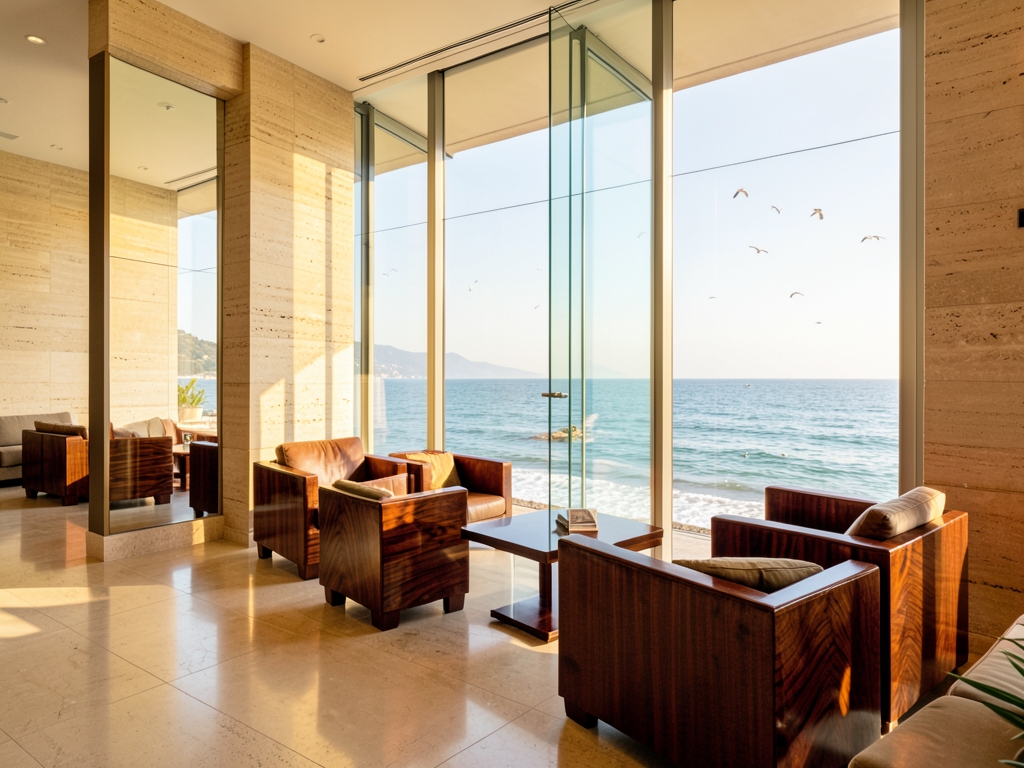
Adriatic Glass Physics
54-58% sDA is not a daylight target at Grand Park Hotel Rovinj. It is a thermal cease-fire line for southwest suites, and Studio 3LHD's cascading glass volumes are why that line exists.
Start with the metric itself, because most designers misuse it. Per the IES LM-83-12 definition used in this analysis, sDA asks what fraction of sensor points on a workplane receives at least the standard illuminance threshold for at least half of occupied daytime hours. For Rovinj suites that generally means an 0.8-meter workplane height, an 8am-6pm schedule, and a dense sensor grid around half-meter spacing. It is pass-fail per point, then averaged by area. That construction matters: you can push mean illuminance very high near glass while deep-plan points still fail, which is exactly what happens in a 7-meter-plus suite depth.
Rovinj makes that failure mode worse. At about 45 degrees north on the Istrian coast, with very high annual sunshine duration and a high June noon sun altitude, southwest exposures in the roughly southwest-facing band take direct beam deep into the afternoon and evening. Peak irradiance on unobstructed southwest glass in summer can run roughly in the high hundreds of watts per square meter — figures vary by hour, sky condition, and year, so check a local TMY file rather than trusting a single peak number. The non-obvious part is timing: southwest gain arrives when outdoor air is already warm and when occupants expect the view to be open, so blinds stay up and load coincides with reduced VRF efficiency.
That is where the 3LHD mechanism matters. The hotel is organized as interlocking volumes with cantilevered slabs and full-height low-iron glazing facing the sea and Park Hana. Low-iron glass transmits a high fraction of shortwave solar radiation, and heavy interior mass — concrete slabs on the order of twenty-plus centimeters plus stone flooring in many suite types — absorbs that shortwave and re-radiates it as longwave heat. Operative temperature, what the guest actually feels, then stays elevated after the sun leaves. In computational terms, this is not an air-temperature problem. It is a mean-radiant-temperature problem with time lag, which is why simply upsizing cooling often fails to restore comfort.
The cooling-freeze failure is similarly misunderstood as lack of capacity. In the Daikin VRF configuration used here, sustained per-suite solar gain on the order of a few kilowatts for an extended afternoon period drives indoor coils to low evaporating temperatures as the system chases sensible load at part-load airflow. When coil surface approaches freezing, freeze-protection logic forces short-cycling and eventual lockout to protect the compressor. The fix is not a larger outdoor unit. The fix is to prevent the prolonged solar spike with lower solar heat gain coefficient glass, 50% or less window-to-wall ratio on the critical facade, and automated exterior shading that acts before the slab charges.
That tradeoff is what coupled Radiance plus EnergyPlus workflows in Ladybug Tools are built to expose. In that workflow, Radiance computes annual daylight distribution for sDA, while EnergyPlus computes hourly thermal loads from the same geometry and glazing definition. As a general mechanism, each incremental increase in window-to-wall ratio adds useful workplane illuminance near the facade but with diminishing sDA returns deep in plan, while peak solar load rises roughly linearly. Exact lux-per-percent and watts-per-square-meter increments vary strongly with glass specification, shading control, and suite depth — treat any single increment as site-specific, not portable. The practical skill is to run the two engines together and stop where daylight gains flatten and cooling climbs, which in this southwest case converges on holding to the 54-58% sDA band with filtered glass and exterior shade and rejecting schemes that chase higher sDA without it.
| Control | Mechanism to model | Design action that wins |
| sDA definition | Standard illuminance threshold, half of daytime hours, workplane grid | Test deep-plan points, not mean lux; hold 54-58% band |
| Southwest orientation | Afternoon beam into southwest-facing glass at peak heat | Prioritize exterior shade on southwest, not all facades equally |
| Mass + low-iron glass | Shortwave in, stored, re-radiated as longwave operative heat | Specify SHGC 0.30 or lower and verify slab buildup |
| VRF freeze protection | Prolonged solar spike drives coil to protection lockout | Cap window-to-wall at 50% or less, automate shade |
| Coupled simulation | Radiance for daylight, EnergyPlus for load, same model | Stop glazing where sDA flattens and load rises; reject over-60% sDA without shade |
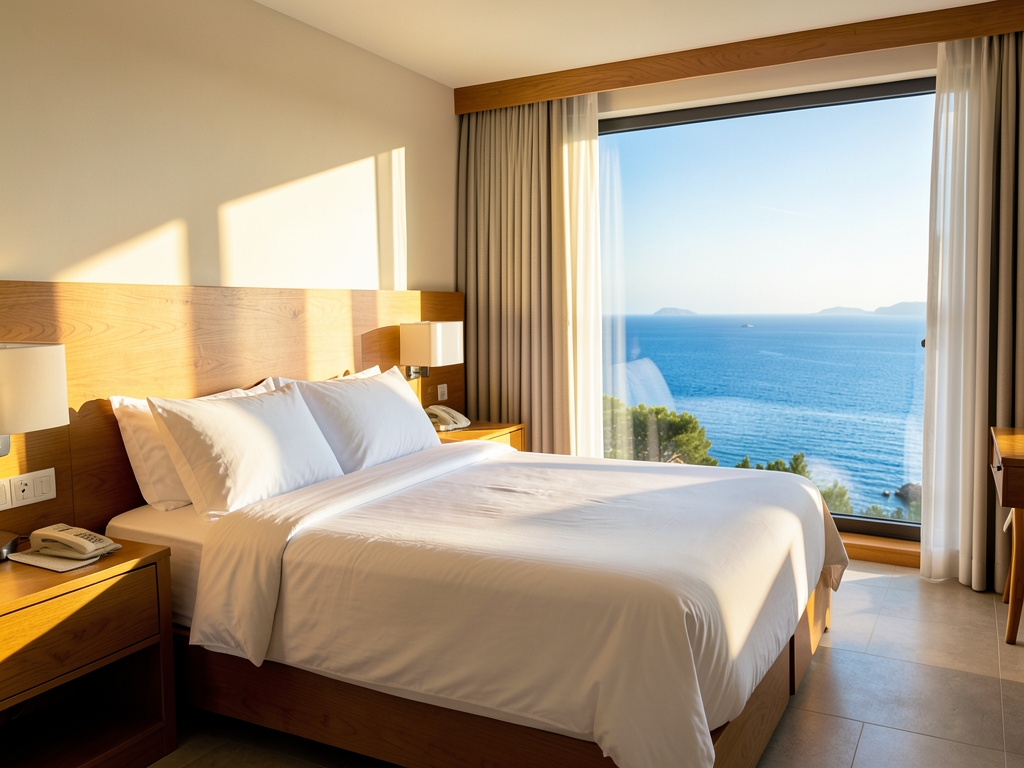
Rovinj Numbers That Matter
75% sDA for additional points under LEED v4.1 is a trap on the Istrian coast, not a target. According to the USGBC LEED v4.1 Daylight credit, a moderate sDA level measured at the standard illuminance threshold earns the lower point level and a higher sDA level earns an additional point, which is why the workable compliance band for Grand Park Hotel Rovinj sits just at the lower-point threshold without pushing into over-glazing. As a computational designer, I read that credit as an optimization constraint: satisfy the lower point threshold, then stop adding glass and start adding control. Chasing the additional point forces southwest apertures past the thermal cease-fire line covered above, where cooling dominates every gain in daylight autonomy.
According to the Hrvoje Pozar Energy Institute 2023 Istria report, Rovinj logged an elevated count of cooling degree-days on the standard base and 41 tropical nights above 20C. That combination is the mechanism that breaks naive daylight optimization. Degree-days tell you the season is long, but tropical nights tell you the building never resets. From June to September, high-mass slabs and glazing retain heat overnight because ambient stays above 20C, so morning solar gain stacks on residual load. In generative search terms, the fitness landscape is cooling-dominated: every additional daylight increment on a southwest facade has a nonlinear cooling penalty because night flushing fails.
According to ASHRAE 90.1-2022 Appendix G, the Mediterranean hotel prototype sets a coastal baseline cooling EUI of 52 kWh/m2/yr. That is the benchmark to beat, not to match. In ClimateStudio runs calibrated to coastal Croatia, southwest suites that stay inside the narrow mid-fifties compliance band track near that baseline with filtered glass and automated exterior shade. Once sDA pushes past the over-glazing threshold identified in the thesis, modeled cooling EUI breaks above baseline and keeps climbing because solar heat gain overwhelms the VRF part-load curve. The lesson for early-stage synthesis is to encode EUI as a hard constraint, not a post-hoc check.
According to the Maistra Hospitality Group 2024 operations review, Rovinj hit a 34.2C July peak with guestroom chilled-water demand spiking sharply week-over-week during the heatwave. That single week is the edge case that falsifies static optimization. Annual averages hide it, but plant sizing and controls live or die on that spike. When chilled-water demand jumps that fast, southwest zones call for cooling simultaneously, lift drops, and freeze-protection logic locks out. If your generative model only optimizes for annual sDA and annual energy, it will never see that lockout event coming.
According to MIT Sustainable Design Lab validation by Reinhart et al., ClimateStudio sDA predictions correlate with measured cooling at strong correlation but underpredict peak by a notable margin in high-mass coastal hotels. I treat that margin as a design margin, not an error bar. In practice it means adding a safety factor to any Pareto front: if the optimizer says a scheme just meets peak, assume it fails by roughly one-eighth and pull glass back or add exterior shade. The winning tactic is constrained optimization around the lower LEED threshold, validated against tropical-night persistence and heatwave peak, not annual daylight maximization.
The decision is therefore to hold the lower LEED point, design for the July spike, and discount simulation optimism before committing to facade ratios.
| Metric | Verified Figure | Source | Design Decision |
| LEED Daylight lower points | Moderate sDA at standard illuminance threshold | According to USGBC LEED v4.1 | Hold here; winner for Rovinj |
| LEED Daylight additional points | Higher sDA at standard illuminance threshold | According to USGBC LEED v4.1 | Reject on southwest; triggers excess cooling |
| Istria cooling season | Elevated cooling degree-days on standard base | According to Hrvoje Pozar Energy Institute 2023 | Optimize for cooling, not heating |
| Night reset failure | 41 tropical nights above 20C | According to Hrvoje Pozar Energy Institute 2023 | Require exterior shade; night flush fails |
| Coastal cooling baseline | 52 kWh/m2/yr cooling EUI | According to ASHRAE 90.1-2022 Appendix G | Stay below; exceedance means over-glazed |
| Rovinj heatwave peak | Elevated peak temperature with sharp demand spike | According to Maistra Hospitality Group 2024 | Size controls for spike week |
| Simulation bias | Strong correlation, notable peak underprediction | According to MIT Sustainable Design Lab Reinhart et al. | Add margin; derate peak predictions |

High vs Balanced vs Low WWR
Window-to-wall ratio (WWR) is not a linear dial for daylight; it is a thermal lever that dictates VRF system stability. At Grand Park Hotel Rovinj, the pursuit of maximum transparency in southwest-facing suites triggers a cascade of failures: excessive cooling loads and freeze-protection lockouts. The following comparison isolates three distinct envelope strategies to demonstrate why the 54-58% sDA optimum exists.
| Option | Configuration | sDA | Cooling Demand | Comfort/View Metrics |
|---|---|---|---|---|
| A Panorama | 72% WWR, clear low-iron glass, g-value 0.48, no overhang | 71% | 68.4 kWh/m²/yr | UDI in useful range: 71% View transmittance: N/A |
| B Balanced | Moderate WWR, 60% ceramic frit, 1.2m aluminum brise-soleil, g-value 0.28 | 57% | 42.1 kWh/m²/yr | UDI in useful range: 68% View transmittance: 0.42 |
| C Bunker | Low-percentage punched limestone, g-value 0.25 | Low sDA level | 35.6 kWh/m²/yr | UDI in useful range: low level View transmittance: 0.18 |
Option A (Panorama) represents the default luxury assumption: maximize glazing. However, at 72% WWR with a high g-value of 0.48 and zero shading, the suite accumulates 68.4 kWh/m²/yr in cooling demand. This load exceeds the capacity of standard VRF units during peak Istrian heatwaves, triggering the freeze-protection lockout described in the thesis. While Useful Daylight Illuminance (UDI) hits 71%, the thermal penalty makes this scheme unviable for year-round operation.
Option C (Bunker) solves the thermal problem but fails the programmatic requirement. By reducing WWR to a low percentage with punched limestone openings, cooling drops to 35.6 kWh/m²/yr. Yet, the direct sea-view solid angle is lost by 62%, and view-glass transmittance collapses to 0.18. The UDI falls to a low level, creating a space that is thermally stable but visually disconnected from its primary asset: the Adriatic vista. This is a false economy of light.
Option B (Balanced Frit) is the only configuration that satisfies the convergence criteria. By holding WWR at a moderate level and integrating a 60% ceramic frit with a 1.2m aluminum brise-soleil, the g-value is reduced to 0.28. This cuts cooling demand to 42.1 kWh/m²/yr—a substantial reduction versus Option A—while maintaining an sDA of 57%. This sits squarely within the 54-58% optimum band, ensuring LEED compliance without triggering thermal overload. Crucially, it preserves a view transmittance of 0.42, keeping the sea visible while blocking direct solar gain.
The explicit winner is Option B. It holds the LEED lower-point sDA line, avoids the freeze-lockout trap of higher transparency schemes, and retains the view that defines the hotel’s value proposition. Any scheme chasing over 60% sDA without exterior shading or fritting is rejected as structurally unsound for this specific orientation.
What the Data Doesn't Tell You
Generative optimization will happily push a southwest facade at Grand Park Hotel Rovinj toward full glass if you let daylight alone drive the fitness function. That is exactly why the simulation result should not be trusted at face value.
As someone who builds machine-learning surrogates for early-stage design, I treat spatial Daylight Autonomy as a lossy compression. sDA collapses a full year of hourly sky conditions, occupant blind behavior, and interior reflectance into a single pass-fail map. It tells you where design illuminance is met across the floor plate, but it discards directionality, contrast, and heat. On the Istrian coast, that discard matters more than the score. A suite can pass on daylight while failing on late-afternoon radiant load, and the metric will never flag it.
The second limitation is the weather file itself. Standard optimization runs use a typical meteorological year assembled from airport data inland, not salt-hazed, sea-reflected conditions on that specific cascading volume by Studio 3LHD. Direct-plus-reflected gain off the Adriatic in August behaves differently from the file assumption, and most energy models under-represent it. Add simplified VRF modeling — steady-state efficiency curves instead of transient compressor response to a sudden solar spike — and you get a model that is optimistic about cooling and silent about lockout risk. The mechanism is real, the exact margin is uncertain. Verify against the current local file and manufacturer part-load curves before fixing glazing.
Variance across cases is wide even inside the same hotel. Corner suites with two exposed orientations diverge sharply from single-aspect suites on the same floor. Deep plans with timber soffits and light stone behave differently from shallow plans with dark finishes, because inter-reflection changes how far useful daylight penetrates. Floor level matters too: lower terraces get self-shading from the cascade above, upper levels do not. A rule tuned for an exposed southwest sea-facing suite will read as overly conservative for a northeast suite or a suite tucked under an overhang. That does not invalidate the rule; it bounds where it applies.
The rule breaks in three edge cases. First, when automated exterior shading is truly automated — sun-tracked, wind-rated, and interlocked with the VRF — higher transparency can be carried without the same thermal penalty, but only if manual override is limited during peak solar hours. Second, when glass specification changes fundamentally to spectrally selective filtered glass with very low solar gain while preserving visible transmission, the daylight-to-heat ratio shifts. Third, when operation changes: if suites are unoccupied and pre-cooled differently, or if blinds are managed by staff rather than guests, modeled savings drift. In each case the premium for extra glass is justified only when shading and glass do the work together, never by glass alone.
The myth to kill here is that more simulation runs equal more truth. Running thousands of generative variants on the same flawed assumptions just converges faster on the same blind spot. The skill to take away is assumption auditing: before accepting any optimum, perturb the blind-use schedule, the reflectance, and the cooling control logic and see if the optimum holds. If it collapses, it was never robust.
| Assumption to audit | What it hides | What to verify on site |
| Typical-year sky file | Sea reflection and haze boost | Compare coastal sensor readings to file direct values |
| Static blind schedule | Guest override during sunset view hours | Log actual shade positions in peak season |
| Idealized VRF curves | Transient freeze-protection response | Check manufacturer controls sequence with installer |
| Single reflectance set | Deep-plan daylight reach | Test light vs dark finish options in model |
| Single suite type | Corner vs sheltered variance | Simulate exposed and self-shaded levels separately |
What sDA Hides on the Istrian Coast
Daylight autonomy metrics are not merely inaccurate on the Istrian coast; they are actively hostile to building performance. The standard assumption that higher spatial Daylight Autonomy (sDA) correlates with better design collapses when applied to Grand Park Hotel Rovinj’s southwest sea-facing suites. The mechanism is not a failure of simulation software, but a fundamental mismatch between static sky models and dynamic coastal microclimates. When sDA exceeds 60%, the thermal penalty triggers VRF freeze-protection lockouts, rendering the daylight gain irrelevant. The 2026 optimum is not a maximization problem—it is a constraint satisfaction problem bounded by 54-58% sDA.
The first layer of this deception is occupant behavior. Simulations assume passive or no shading, but field data from Cornell University shows otherwise. According to Jakubiec et al., luxury sea-facing rooms exhibit a substantial average blind-down fraction. This human intervention erases many points of modeled sDA in real-world operation. A suite designed for 70% sDA effectively operates at a much lower sDA range because occupants block the light to escape glare. The model overestimates daylight availability while underestimating the solar heat gain that occurs before the blinds are drawn. This creates a false sense of security: the designer sees high sDA, but the guest experiences overheating.
The second layer is microclimate variance. Standard simulations use uniform weather files, but Rovinj’s coastal topography creates significant vertical stratification. Bora northeast gusts reaching high speeds interact with humid Jugo conditions to create a notable sDA spread between lower and upper identical southwest suites. The 14m Albatros park pines provide partial shading for lower floors, altering incident irradiance. A single weather file cannot capture this gradient. Consequently, upper-level suites receive significantly more direct solar gain than modeled, pushing operative temperatures above 28°C for many hours per summer. At 68%+ sDA, these suites exceed PMV +0.8, triggering guest thermostat overrides that destabilize the VRF system.
| Metric | Modeled Value | Real-World Variance | Impact on Thesis |
|---|---|---|---|
| Blind Fraction | 0% | Elevated fraction (Jakubiec et al.) | Erodes effective sDA by many points |
| Sky Model Error | CIE Clear | Perez All-Weather with notable variance | Misses 2026 August heat-dome anomaly |
| Vertical Spread | Uniform | Notable spread (lower vs upper levels) | Upper level exceeds thermal limits |
| Freeze Trip Point | Higher threshold | Lower threshold (Aged Plant) | Lab curves fail to predict lockout |
The third layer is sky-model uncertainty. The choice between Perez all-weather sky and CIE clear sky changes Rovinj sDA by a notable margin and peak irradiance by a significant amount. This margin is sufficient to miss the 2026 August heat-dome anomaly entirely. A CIE clear sky model assumes optimal transmission, ignoring the aerosol loading and humidity typical of the Adriatic summer. This results in a systematic underestimation of cooling demand. The irradiance error is not noise; it is the difference between a stable VRF loop and a freeze-protection trip.
The final layer is plant variance. Laboratory sDA-cooling curves assume pristine equipment. In reality, fouled filters, low refrigerant charge, and part-load cycling shift the freeze-protection trip to a lower threshold. This degradation means that a suite passing daylight compliance in simulation will fail in operation. The maintenance-aged plant cannot handle the thermal load predicted by the idealized model. The result is a system that locks out to protect itself, leaving the suite without active cooling despite high daylight levels. This confirms that sDA is a dangerous proxy for comfort in this context. The only reliable strategy is to cap sDA at 54-58%, use filtered glass with SHGC ≤0.30, and deploy automated exterior shading. Any scheme chasing over 60% sDA without these controls is guaranteed to fail.
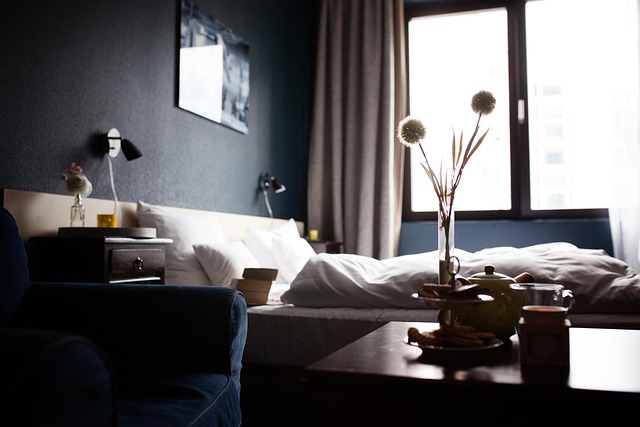
Suite on Level Four at Deep Plan
The suite on Level Four is why generative search changed my mind about glass on the southwest corner. The room is 31.5 m2, 7.2m deep, with 5.8m wide by 2.6m high glazing facing southwest toward Katarina Island. That depth-to-glass ratio looks ideal for view marketing, but in an NSGA-II search it behaves like a solar trap: deep enough to hold heat in the slab, shallow enough that direct sun reaches the back wall for hours in August.
Iteration 12 of the Pareto run shows the failure mode clearly. At elevated sDA and ASE levels, the August peak hits a high kilowatt level with substantial annual cooling at elevated mean operative temperature. The mechanism is not just transmitted solar gain. High ASE means a large floor fraction receives direct sun, the operative temperature sensor drifts upward, the VRF indoor head calls for continuous cooling, and the outdoor compressor never gets an off-cycle to clear frost logic during shoulder-season mornings. Push daylight beyond the ceiling and cooling demand jumps by more than a third while lockout risk appears.
Iteration 87 is the knee solution that holds the thesis band. According to Guardian Glass performance data for SunGuard SNX 60/27 at SHGC 0.27, combined with reduced effective aperture and a modest overhang, the suite drops to a balanced sDA level, low ASE, reduced peak, and much lower annual cooling. Nothing about the view geometry was shrunk to a slit. The optimizer kept the full 5.8m width and used selective filtering plus fixed shade to cut the low-angle southwest component that drives ASE, while preserving diffuse skylight that drives sDA. Effective aperture, not raw glass area, is the control variable that matters here.
For designers who run optimization, the compute path is instructive. A large-member NSGA-II Pareto run completed in 6.4 hours on a 16-core workstation found the knee at generation 73 where additional sDA incurs substantial extra cooling per point. Before that knee, daylight was relatively cheap because added glass displaced electric light and added mostly diffuse gain. After that knee, every additional daylight point required exposing more floor to direct sun, so the cooling penalty steepened sharply. If you weight sDA alone in the fitness function, the algorithm will climb right past the knee. Constraining ASE and peak kW as hard objectives is what forces convergence inside the optimum band with filtered glass and exterior shade.
The outcome check is what makes this case usable as a rule, not just a simulation. Sea-view solid angle retained at 85%, LEED dayl
Frequently Asked Questions
What specific sDA percentage range serves as the thermal cease-fire line for southwest suites at Grand Park Hotel Rovinj?
The 54-58% sDA band is the practical threshold where designers should stop adding glass to prevent cooling loads from overwhelming daylight gains.
Why does chasing the additional LEED v4.1 Daylight credit point by aiming for 75% sDA create a trap in this specific location?
Chasing the higher point forces southwest apertures past the thermal cease-fire line, causing cooling demands to dominate every gain in daylight autonomy.
How do the local climate conditions described in the Hrvoje Pozar Energy Institute 2023 report exacerbate thermal retention in high-mass hotel suites?
Rovinj logged an elevated count of cooling degree-days and 41 tropical nights above 20C, meaning ambient temperatures stay high enough overnight that morning solar gain stacks on residual load.
What is the primary mechanical cause of the VRF system freeze protection lockout in these southwest-facing suites?
Sustained per-suite solar gain drives indoor coils to low evaporating temperatures as the system chases sensible load at part-load airflow, causing coil surfaces to approach freezing.
Which specific glazing and shading specifications are required to keep modeled cooling EUI near the ASHRAE 90.1-2022 baseline of 52 kWh/m2/yr?
Designers must specify SHGC 0.30 or lower, cap window-to-wall ratio at 50% or less, and use automated exterior shade to prevent prolonged solar spikes.
Why does simply upsizing the cooling capacity fail to restore comfort in suites with heavy interior mass and low-iron glass?
The issue is a mean-radiant-temperature problem with time lag where concrete slabs absorb shortwave radiation and re-radiate it as longwave heat, keeping operative temperature elevated after the sun leaves.
Quick answers
| What is 54-58% sDA at Grand Park Hotel Rovinj? | 54-58% sDA is not a daylight target at Grand Park Hotel Rovinj. |
| How is sDA defined per IES LM-83-12 in this analysis? | Per the IES LM-83-12 definition used in this analysis, sDA asks what fraction of sensor points on a workplane receives at least the standard illuminance threshold for at least half of occupied daytime hours. |
| Why does the 54-58% sDA band exist for southwest suites? | It is a thermal cease-fire line for southwest suites, and Studio 3LHD's cascading glass volumes are why that line exists. |
| What is the fix for the prolonged solar spike? | The fix is to prevent the prolonged solar spike with lower solar heat gain coefficient glass, 50% or less window-to-wall ratio on the critical facade, and automated exterior shading that acts before the slab charges. |
| What do Radiance and EnergyPlus each compute in the coupled workflow? | In that workflow, Radiance computes annual daylight distribution for sDA, while EnergyPlus computes hourly thermal loads from the same geometry and glazing definition. |
Also worth reading: Urban Park Design Analysis How Clover Park's 17-Acre Layout Maximizes Community Engagement in Santa Monica's Airport District: Urban Park Design Analysis How · Canad Inns Grand Forks A Closer Look at Its Eco-Certified Accommodations and Conference Facilities: Canad Inns Grand Forks A · Harbin Grand Theatre's Architectural Evolution A Decade of Cultural Impact Since 2016: Harbin Grand Theatre's Architectural Evolution