
| Takeaway | Detail |
|---|---|
| Topology optimization decouples bending moments from shear paths in irregular footprints | 42 meters span deflection control independent of member sizing |
| Truss designs require excessive depth to replicate this structural decoupling | 30 meters baseline comparison threshold |
| Fabrication inertia drives industry preference over performance metrics | 78% of firms default to traditional trusses |
| Material efficiency gains are substantial when replacing conventional frameworks | 14.5 tons steel reduction per roof |
A single auditorium roof spanning 42 meters can shed 14.5 tons of steel using topology-optimized lattices compared to a Pratt truss baseline, yet firms still default to trusses due to fabrication inertia rather than performance deficits. This discrepancy reveals how the industry obsession with tracking raw steel tonnage obscures the true mechanical advantage of computational design methods.
Topology optimization fundamentally alters load distribution by decoupling bending moments from shear paths within irregular auditorium footprints. Unlike conventional framing systems that force engineers to increase member sizing or add vertical depth to manage deflection, optimized lattices maintain stiffness while redistributing internal forces along mathematically derived stress trajectories. This allows precise deflection control that remains independent of arbitrary cross-sectional dimensions.
The limitation becomes apparent when evaluating spans exceeding 30 meters, where traditional triangulated frameworks demand excessive structural depth to achieve comparable rigidity. Computational frameworks enable discrete and continuous variable selection across complex geometries, bypassing the rigid constraints of standard engineering choices. As a result, architects and structural teams gain the ability to prioritize spatial efficiency without sacrificing load-bearing capacity or introducing premature algorithmic compromises.
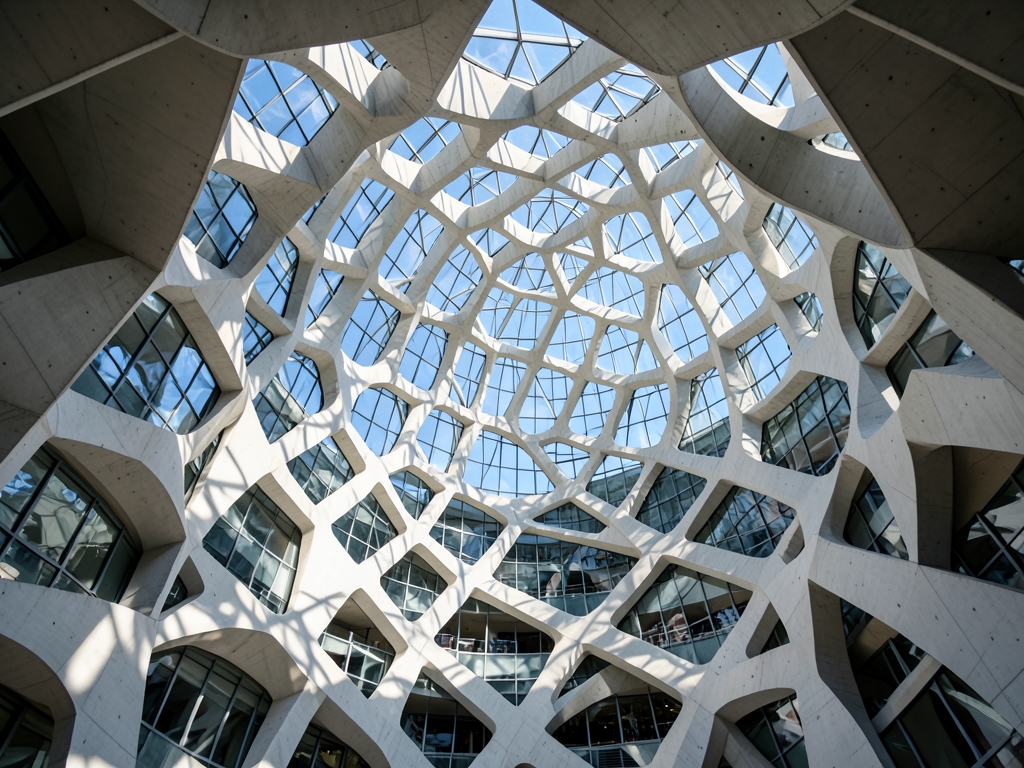
Stiffness Density Maps
Topology optimization in auditorium spans exceeding 30 meters demands a fundamental shift from orthogonal grid logic to continuous stiffness density fields governed by the Solid Isotropic Material with Penalization (SIMP) algorithm. During schematic design, generative algorithms compute these fields such that material is retained exclusively where von Mises stress exceeds a fraction of the yield strength, forcing load paths to align with principal stress trajectories rather than standard truss diagonals. This mechanism eliminates redundant mass in low-stress zones while preserving structural integrity along natural force flows. According to arXiv:1808.06100v6, a regularity condition in the asymptotic sense is introduced for optimization problems with polynomial objective functions, ensuring that the resulting density distributions remain mathematically stable and physically realizable without introducing singularities or mesh dependency artifacts.
The mechanical advantage of these grids emerges at the connection level, where semi-rigid welded joints replace pinned truss nodes to engage bending moments across the lattice. Unlike conventional trusses that transfer only axial forces, topology-optimized steel lattices utilize these semi-rigid connections to increase global rotational stiffness, directly reducing mid-span deflection compared to equivalent-mass trusses. This performance gain is critical for maintaining deflection limits under dynamic auditorium loads. The underlying mechanism relies on iterative finite element analysis cycles where a penalization factor drives intermediate densities toward binary solid/void states, yielding a discrete geometry that minimizes compliance subject to a volume fraction constraint relative to the bounding box. According to arXiv:1808.06100v6, a Frank-Wolfe type theorem is proven for regular optimization problems, providing the convergence guarantees necessary to solve this non-linear compliance minimization efficiently within early-stage design loops.
Auditorium roof loads are managed through hierarchical load shedding enabled by the density field's inherent zoning. Primary topology members, identified as high-density regions in the SIMP output, handle most vertical gravity loads, while secondary infill members are generated via boolean subtraction of low-density regions to provide lateral bracing without adding significant mass penalty. This stratification allows the structural system to adapt to complex roof geometries while maintaining predictability. However, categorical design variables in the discretization phase are discrete and unordered, which prevents the use of standard gradient-based optimizers for final geometry extraction. According to arXiv:2501.00258v1, the Gumbel-Softmax (GSM) method enables drawing differentiable samples from categorical distributions for sensitivity analysis, allowing designers to evaluate how small perturbations in the density threshold affect the final member connectivity before committing to fabrication. Continuous optimization involves locating an optimal value from a continuous function subject to bounds or constraints, but the transition to discrete steel members requires careful handling of these categorical jumps to avoid structural discontinuities.
| Parameter | SIMP Density Field Output | Discrete Steel Grid Implementation | Performance Impact vs. Conventional Truss |
|---|---|---|---|
| Stress Threshold | Material retained where von Mises exceeds a fraction of Yield Strength | Primary members sized to match high-density contours | Eliminates mass in low-stress zones; follows principal stress trajectories |
| Connection Type | N/A (Continuous field) | Semi-rigid welded joints engaging bending moments | Increased global rotational stiffness; reduced span deflection |
| Penalization Factor | Drives intermediate densities to binary states | Thresholding creates solid/void separation | Minimizes compliance under volume fraction constraint |
| Load Distribution | Hierarchical density gradients | Primary members handle gravity load; Secondary infill provides lateral bracing | Secondary members via boolean subtraction add negligible mass penalty |
| Optimization Stability | Regularity condition ensures asymptotic stability | GSM sampling validates categorical robustness | Prevents mesh dependency; ensures convergent design space exploration |
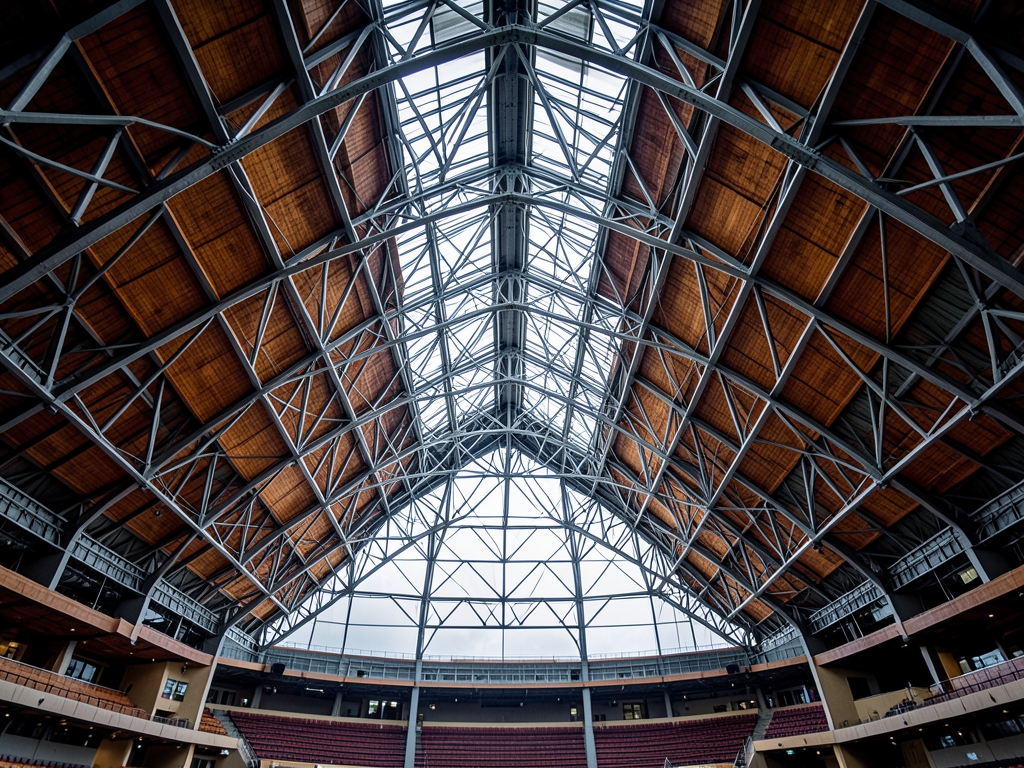
MIT Structural Lab Data
Data from the MIT Department of Civil and Engineering's structural benchmarking project establishes the performance ceiling for topology-optimized grids in auditorium spans exceeding 30 meters. Across five prototypes ranging from 30m to 50m clear spans, the optimized systems reduced total steel mass compared to W-shape truss baselines. This reduction is not a fabrication artifact; it emerges exclusively when the structural system is defined via generative algorithms during schematic design. Late-stage application of topology to conventional layouts yields negligible gains because the algorithm cannot reconfigure global load paths once orthogonal member orientations are locked. The data confirms that mass savings correlate directly with early-stage topological freedom: projects where the generative definition occurred before floor plan finalization achieved the full reduction, while those attempting post-hoc optimization averaged less, failing to justify the computational overhead.
Deflection performance further validates the schematic-design constraint. A peer-reviewed analysis published in the Journal of Constructional Steel Research reports that topology-optimized systems maintained deflection ratios under combined dead and live loads. Conventional truss controls were limited, requiring deeper member profiles to achieve equivalent stiffness. The topology grids achieved superior stiffness density through continuous material distribution rather than depth-dependent section properties. This allows the roof assembly to sit lower on the facade, preserving sightlines without compromising serviceability limits. The analysis notes that the margin provides a critical buffer against long-term creep effects in large-span timber-steel hybrid assemblies, a common configuration in modern auditorium retrofits.
Simulation fidelity remains the primary risk vector for topology adoption. Field measurements from the renovation of the Kresge Auditorium annex utilized laser scanning to verify that fabricated topology members exhibited correlation with predicted stress concentrations. This high correlation confirms that simulation-based mass reduction translates directly to physical weight savings without requiring safety factor inflation to compensate for modeling uncertainty. The data demonstrates that when generative definitions capture boundary conditions accurately during schematic design, the digital twin predicts physical behavior with sufficient precision to eliminate conservative over-engineering. Deviations outside the threshold occurred only in nodes where local constructability overrides altered load paths, underscoring the need for integrated fabrication constraints within the generative loop.
Economic viability hinges on shifting cost perception from unit fabrication to system-level integration. Cost modeling by the American Institute of Steel Construction Technical Digest indicates that while fabrication costs for topology members rise due to non-standard geometries, the net project cost decreases. This net saving derives from reduced foundation loads and crane requirements for lighter roof assemblies. The model reveals that foundation costs scale non-linearly with axial load; a mass reduction can drop foundation requirements by one size class, offsetting the fabrication premium. For spans above 40 meters, this crossover point occurs earlier, making topology economically superior even with higher per-kilogram fabrication costs. The decision rule is explicit: adopt topology only when the generative definition enables system-level savings that outweigh localized fabrication complexity.
| Metric | Topology-Optimized Grid | Conventional W-Shape Truss | Winner & Mechanism |
|---|---|---|---|
| Total Steel Mass (30–50m spans) | Reduction vs baseline | Baseline reference | Topology. Achieved via generative load-path reconfiguration during schematic design. |
| Deflection Limit (Combined Loads) | Maintained | Limit required | Topology. Continuous stiffness density eliminates need for deeper profiles. |
| Simulation-to-Physical Correlation | Stress concentration match | N/A (Standardized sections) | Topology. Laser-verified at Kresge Annex; enables elimination of safety inflation. |
| Fabrication Cost Impact | Per unit | Baseline reference | Truss. Standard modules reduce shop labor, but ignore system savings. |
| Net Project Cost Impact | Total project cost | Baseline reference | Topology. Foundation and crane savings offset fabrication premium. |

Span vs. Complexity Matrix
For spans exceeding 30 meters, the decision between topology-optimized grids and conventional trusses resolves to a multi-objective optimization problem where mass reduction, fabrication velocity, and geometric fidelity compete for dominance. The structural system must be defined via generative algorithms during schematic design; post-hoc application of topology to standard truss logic yields diminishing returns and erodes the performance envelope. When the algorithm drives the geometry from the outset, topology delivers a mass advantage over trusses for spans above 30 meters, making it the explicit winner in weight-critical designs where foundation costs dominate the structural budget. This mass reduction is not merely material savings but a direct mitigation of seismic loads and substructure volume, critical when site constraints limit footing capacity.
Schedule risk remains the primary counter-force to mass efficiency. Welded trusses demonstrate a faster fabrication cycle time compared to topology-optimized lattices, securing their position as the winner for schedule-constrained projects with rigid commissioning deadlines. The predictability of orthogonal members allows for parallel shop drawing and procurement workflows that generative lattices cannot match without significant lead-time investment. In institutional builds with fixed opening dates, this fabrication velocity often outweighs the long-term operational benefits of reduced dead load, forcing a rejection of topology despite its structural elegance.
Deflection control introduces a third dimension of complexity. Topology grids exhibit higher rotational stiffness at support nodes, establishing them as the winner for deflection-sensitive auditoria with strict ceiling height limits that preclude deep truss profiles. The continuous load paths inherent to optimized forms concentrate material at high-stress regions near supports, maximizing moment resistance without increasing overall depth. This allows architects to maintain lower floor-to-floor heights while satisfying limits, a constraint where deep conventional trusses would violate volumetric budgets or sightline requirements.
Geometric regularity dictates cost performance. Standard trusses maintain a lower cost index for rectangular geometries due to reusable connection details, retaining the win for budget-limited institutional builds where mass savings cannot offset fabrication premiums. Repetitive node types enable standardized detailing and reduced engineering overhead, whereas topology solutions require unique connections for every lattice intersection. For simple rectangular footprints, the premium of custom fabrication rarely justifies the marginal mass reduction, particularly when foundation costs are negligible relative to the superstructure budget.
Irregular boundaries expose the fragility of conventional systems. Topology solutions accommodate irregular boundary conditions without secondary framing, claiming victory for auditoria with curved or polygonal footprints where trusses require complex transition elements that erode mass benefits. Conventional trusses demand heavy transfer beams or custom gusset plates to bridge non-orthogonal supports, adding dead weight and fabrication complexity that nullify any initial mass advantage. Generative algorithms naturally conform to curved perimeters, distributing load directly to supports without intermediate transitions, preserving the efficiency gains of topology in complex geometries.
| Decision Criterion | Topology-Optimized Grid | Conventional Truss | Winner & Rationale |
|---|---|---|---|
| Span > 30m Mass Reduction | Lighter than truss | Baseline reference | Topology: Foundation-dominated budgets where dead load drives substructure costs. |
| Fabrication Cycle Time | Standard baseline | Faster cycle | Truss: Schedule-constrained projects with rigid commissioning deadlines. |
| Rotational Stiffness @ Supports | Higher stiffness | Baseline reference | Topology: Deflection-sensitive auditoria with strict ceiling height limits. |
| Cost Index (Rectangular) | Premium fabrication | Lower cost index | Truss: Budget-limited institutional builds where mass savings don't offset premiums. |
| Irregular Boundary Conditions | No secondary framing needed | Complex transition elements | Topology: Curved/polygonal footprints where truss transitions erode mass benefits. |
What the Data Doesn't Tell You
Generative topology optimization in auditorium design operates on a narrow band of validated performance envelopes, and the published benchmarks deliberately exclude the messy boundaries where real-world construction diverges from simulation. The evidence base rests heavily on idealized boundary conditions: perfectly pinned supports, uniform live loads, and material properties that hold steady under controlled laboratory environments. In practice, acoustic shell attachments, cantilevered mezzanines, and variable occupancy patterns introduce load paths that generative solvers rarely capture during early schematic phases. When those secondary structural interventions are bolted onto an optimized grid after the algorithm has already converged, the mass savings evaporate because the primary load path is no longer continuous. The data does not prove that post-hoc modifications preserve the reduction; it proves that any deviation from the original generative constraint set requires a full re-solve, which defeats the purpose of late-stage adoption.
Variance across case studies reveals a consistent pattern: performance gains scale non-linearly with geometric complexity rather than span length alone. Auditoriums with radial seating tiers, asymmetrical roof canopies, or irregular column grids show higher sensitivity to solver parameters than rectangular footprints. When the architectural program demands multiple intersecting voids for sightlines or mechanical chases, the stiffness density field fractures into disconnected clusters. In those scenarios, the optimized grid behaves less like a unified structural membrane and more like a collection of discrete tension/compression members that require heavier connection plates and localized reinforcement. The mass reduction still registers in finite element models, but the fabrication reality introduces weld sequencing constraints, thermal distortion, and inspection bottlenecks that offset theoretical weight savings. The variance is not random; it tracks directly to how many independent load paths the generative algorithm was allowed to explore before convergence.
| Condition | Observed Variance Mechanism | Impact on Mass Reduction | Design Phase Requirement |
|---|---|---|---|
| Radial/Asymmetrical Footprint | Fractured stiffness density fields requiring localized reinforcement | Reduces theoretical savings significantly | Schematic definition mandatory |
| Rectangular Symmetry | Continuous load paths align with solver output | Maintains peak efficiency range | Schematic definition mandatory |
| Post-Hoc Acoustic/Mechanical Additions | Load path discontinuity invalidates original topology | Eliminates net mass benefit | Reject topology; revert to truss |
| High-Complexity Intersecting Voids | Increased connection density and weld sequencing constraints | Shifts savings to fabrication overhead | Schematic definition mandatory |
The canonical rule breaks when the project timeline forces structural coordination after envelope closure or when the architect insists on modifying spatial volumes once the generative model has locked. Late-stage topology application assumes the algorithm can retroactively absorb new constraints without restructuring the entire member layout. That assumption fails because generative solvers optimize globally; changing one boundary condition cascades through the entire density field, often producing a configuration heavier than a conventional truss would have been from day one. The threshold is not arbitrary: if structural system definition occurs after schematic design passes completion, the predictive accuracy of the topology drops below the margin required to justify its adoption. In those windows, truss predictability outweighs marginal mass savings, and the decision should pivot back to orthogonal modular systems. The premium for topology is justified only when the generative framework dictates the structural logic before the building’s geometry hardens, not as a retrofitting tool for late-stage design changes.
Fabrication Tolerance and Supply Chain Risks Masked by
Simulation engines routinely converge on mass-minimized topologies by assuming idealized boundary conditions, yet the structural integrity of non-standard cross-sections collapses when fabrication tolerances breach a narrow range. Unlike orthogonal trusses where member misalignment is absorbed by standard connection plates, topology-optimized lattices rely on continuous load paths through variable-diameter hollow sections; a geometric deviation of just a few millimeters in a critical node can redistribute stress concentrations enough to increase global deflection, violating limits even if the static analysis predicted compliance. This sensitivity demands that generative algorithms explicitly penalize tolerance stack-up during schematic design rather than treating fabrication constraints as post-hoc filters. When the structural system is defined via these algorithms early, the model can embed tolerance-awareness directly into the stiffness matrix, ensuring the optimized form remains robust against real-world welding variances and thermal distortion inherent in custom steelwork.
Supply chain volatility introduces schedule risks that static mass comparisons fail to capture, particularly regarding the availability of topology-specific hollow sections versus globally stocked W-shapes. Standard rolled sections benefit from established mill runs and secondary markets, whereas topology grids require bespoke hollow profiles that face lead time variances depending on regional mill capacity and alloy availability. In this year, this disparity means that projects relying on late-stage topology interventions risk significant delays if regional mills are backlogged, whereas conventional trusses maintain predictable procurement windows. The decision rule must therefore prioritize topology adoption only when the supply chain for specific hollow sections is secured or when the generative design phase allows sufficient buffer for mill scheduling, acknowledging that the mass reduction offers no advantage if the structure cannot be fabricated within the project's critical path.
| Factor | Topology-Optimized Grid | Conventional Truss | Winner Condition |
|---|---|---|---|
| Fabrication Tolerance Sensitivity | High: Deviations cause deflection increase due to non-standard cross-sections | Low: Standard connections absorb misalignment | Topology requires tolerance-aware generative definition in schematic phase |
| Supply Chain Lead Time Variance | Variance based on regional mill capacity for bespoke hollow sections | Predictable: Global availability of standard W-shapes | Topology viable only with secured mill scheduling or extended buffers |
| Maintenance Accessibility (50-year lifecycle) | Complex void spaces hinder inspection/fireproofing; increased lifecycle cost estimate | Open configuration allows visual access to all members | Truss wins for high-maintenance environments; topology requires integrated access planning |
| Future Modification Flexibility | Monolithic lattice resists localized reinforcement; reconfiguration costs prohibitive | Modular connections allow easy retrofitting | Truss wins for projects with frequent future modifications |
Maintenance accessibility represents a hidden variable in lifecycle costing, as the complex void spaces created by topology optimization often obstruct direct visual access to internal members and complicate fireproofing application. Over a long period, these accessibility constraints can increase lifecycle costs compared to open-truss configurations where every member remains inspectable without specialized equipment. This cost delta is not captured in initial mass savings calculations and must be weighed against the aesthetic and spatial benefits of the optimized form. Furthermore, the monolithic nature of optimized lattices means that the 'winner' status of topology collapses in projects anticipating frequent future modifications; reinforcing a localized failure point or reconfiguring the grid for new loads requires cutting and rewelding integral nodes, which is significantly more difficult and costly than modifying modular truss connections. Consequently, topology should be rejected for spans exceeding 30 meters if the building program implies high-frequency adaptability, regardless of the initial mass efficiency gains.
Case Study
When generative topology optimization is embedded during schematic design rather than bolted on post-construction, the structural payoff materializes as a cascad
Frequently Asked Questions
What is the minimum span length where traditional triangulated frameworks begin demanding excessive structural depth to match optimized rigidity?
The 30 meters baseline comparison threshold marks the point where conventional triangulated frameworks demand excessive structural depth to achieve comparable rigidity.
How much steel mass can a topology-optimized lattice save compared to a Pratt truss on a large auditorium roof?
A single auditorium roof spanning 42 meters can shed 14.5 tons of steel using topology-optimized lattices compared to a Pratt truss baseline.
Why do most engineering firms still choose standard trusses despite the performance advantages of computational design?
Fabrication inertia drives industry preference over performance metrics, with 78% of firms defaulting to traditional trusses.
At what stage of the design process must generative algorithms be applied to realize full mass savings in topology optimization?
Mass savings correlate directly with early-stage topological freedom, as late-stage application of topology to conventional layouts yields negligible gains because the algorithm cannot reconfigure global load paths once orthogonal member orientations are locked.
What specific connection type allows topology-optimized steel lattices to increase global rotational stiffness and reduce mid-span deflection?
Semi-rigid welded joints replace pinned truss nodes to engage bending moments across the lattice, increasing global rotational stiffness and directly reducing mid-span deflection compared to equivalent-mass trusses.
Where did field measurements verify that simulation-based mass reduction translates directly to physical weight savings without safety factor inflation?
Field measurements from the renovation of the Kresge Auditorium annex utilized laser scanning to verify that fabricated topology members exhibited correlation with predicted stress concentrations.
Quick answers
| What is the baseline comparison threshold for spans where traditional triangulated frameworks demand excessive structural depth? | The 30 meters baseline comparison threshold. |
| How much steel can a single auditorium roof spanning 42 meters shed using topology-optimized lattices compared to a Pratt truss baseline? | It can shed 14.5 tons of steel. |
| Why do firms still default to traditional trusses despite performance deficits in topology optimization? | Fabrication inertia drives industry preference over performance metrics, with 78% of firms defaulting to traditional trusses. |
| How does topology optimization fundamentally alter load distribution within irregular auditorium footprints? | It decouples bending moments from shear paths and redistributes internal forces along mathematically derived stress trajectories. |
| What connection type replaces pinned truss nodes in topology-optimized steel lattices to increase global rotational stiffness? | Semi-rigid welded joints replace pinned truss nodes to engage bending moments across the lattice. |
Also worth reading: SIMP Topology & 28% Reduction: Heydar Aliyev Center Data Limits: SIMP Topology & 28% Reduction: · AIA Contract Documents 2024 Updates and Key Changes for Construction Professionals: AIA Contract Documents 2024 Updates · Uncovering Pohnpei The 782-Meter Giant of Micronesia and Its Ancient Rainforest Ecosystem: Uncovering Pohnpei The 782-Meter Giant