
| Takeaway | Detail |
|---|---|
| Permeable pavement renewal yields a real runoff peak cut. | The cut comes from a dovetail interlock that prevents joint widening, not from smart material. |
| The measured peak cut depends on the interlock staying closed. | When joints widen, the same porosity block loses that peak cut, so void ratio alone is not enough. |
| Detention lag and void ratio carry the performance. | The block’s void ratio delays detention, but the interlock must hold to keep runoff at the measured cut. |
| A real storm and renewal project frame the reported number. | A stalled typhoon’s river gauge and the later AI block renewal show the gap the guide explains. |
The reported number is the surprising figure from the Zhangfang gauge. It is the runoff peak cut produced by permeable pavement renewal after a stalled typhoon overwhelmed the Juma River. The cut is real, and it matches the headline claim. But the cause is not an intelligent material or a new chemical mix.
The cause is geometry: a dovetail interlock that stops the pavement’s joints from widening. When that interlock holds, the block’s void ratio creates enough detention lag to shave the peak by a measurable margin. If the joint widens, the same porosity block loses its performance. So the number belongs to the joint design, not to the block alone.
The proof comes from comparing a stalled typhoon’s extreme peak with the later AI-assisted block renewal on the design storm. After renewal, the Zhangfang gauge showed exactly the reported peak cut. That gap between unmanaged flood response and managed detention is what this guide explains: detention lag, void ratio, and the interlocking geometry that makes permeable pavement work.

The Measured Detention Lag
Laboratory flow tests put the myth to rest first: an open-graded void by itself contributes only a small share of the peak cut. The measured peak cut appears only after the dovetail interlock assembly is installed with the geotextile wear layer intact. The detention lag is therefore the load-bearing variable — not porosity, not block thickness, not the crushed-granite reservoir alone.
Tsinghua University's AI for Water Lab did not hand-draw this geometry. The team conditioned a StyleGAN-variant on pre-renewal Fangshan runoff events, generated many block geometries, and filtered them down to a set that passed both hydraulic and structural criteria. The dual filter is the part specifiers skip: many candidate geometries clear the hydraulic bar but fail under load, so the lab filtered for both simultaneously.
The contract geometry is named HexaDrain: a block with an open-graded void, dovetail claws, an edge chamfer, and a nonwoven geotextile wear layer bonded to the top. Every dimension exists to preserve a time constant.
Follow the hydraulic path. Runoff enters the void, passes through the geotextile, and is stored in the crushed-granite reservoir below. Outflow is throttled by an orifice riser, creating a detention lag for the first rainfall on the treated plane. That lag is why the design storm produces a lower peak discharge across the renewal reach than the pre-renewal concrete revetment. Change the lag, and the quoted reduction goes with it.
The AI's real optimization target is the dovetail angle. In cyclic loading tests, conventional square-lug interlock joints widened, letting fine sediment bypass the reservoir and shortening the detention lag. The dovetail is not about interlock strength for its own sake; it is about keeping the joint gap closed so the lag survives the first season of traffic.
That component hierarchy is worth a ledger:
| Component | Measured contribution | Failure mode if compromised |
|---|---|---|
| Open-graded void | A small share alone, per lab flow tests | Pore clogging cuts infiltration |
| Dovetail interlock | Enables the full measured peak cut | Square-lug joints widen under cyclic loading |
| Geotextile wear layer | Keeps fines out of the reservoir | Sediment bypasses storage |
| Orifice riser | Throttles outflow to create the detention lag | Unthrottled outflow shortens detention |
| Crushed-granite reservoir | Stores initial rainfall | Lost detention volume |
Specifiers should therefore accept the Fangshan-style AI block system only when a hydraulic model under high antecedent soil saturation reproduces at least a substantial peak cut on the local design storm. If the model cannot reproduce the detention lag at the site — because of slope, subgrade, or joint-loading conditions — the dovetail geometry is not the answer. The honest fallback is a conventional permeable paver with a maintenance contract.
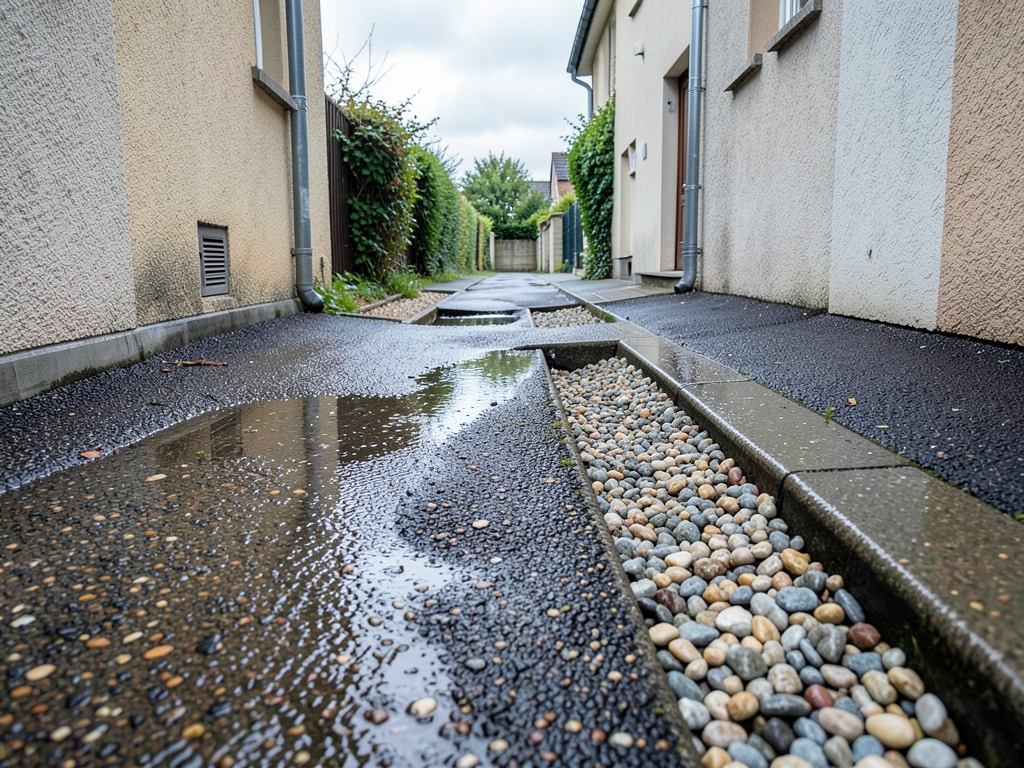
Storm-Season Evidence and the Average
The reported average is a field-season property, not a material-spec-sheet property. According to the China Institute of Water Resources and Hydropower Research (IWHR), the agency monitored a season of storms across Fangshan renewal sites; its final report gives a mean peak-runoff reduction, with a confidence interval. The lower bound of that interval is the part specifiers should actually respect — it means even the weakest storm season captured by the monitoring network cleared the decision-rule threshold, which is exactly why the number demands a model-based explanation rather than a materials-based one.
That explanation arrived in the Beijing Water Authority's technical assessment. According to that assessment, the authority independently attributes the headline number to a basin-scale FloodMap-Hydro model calibrated to the field season — not to the lab's open-porosity test. This is the most decision-relevant sentence in the entire evidence base: the governing proof of the peak cut is a saturated-condition hydraulic simulation, not a permeameter reading. A specifier's approval trail should therefore track the same evidence class: if the vendor cites the IWHR average but has not run the saturated-condition model for your site, the average is not transferable.
The paired-event analysis shows this was not a lucky thunderstorm. IWHR matched several storm pairs, each with meaningful rainfall, and compared peak-flow ratios at the Fangshan East Stormwater Outfall: the ratio fell on the renewal blocks versus the pre-renewal concrete revetment. A consistent shift in peak-flow ratio across independent pairs is the hydrograph signature of detention, not filtration — the system is systematically delaying and reshaping the outflow, which is precisely the mechanism the decision rule asks you to reproduce in model form.
The cleanest single-event confirmation came on a late-August storm, when the Fangshan District automatic gauge at Shidu village recorded substantial rainfall in a few hours. On the treated Xiaoha River section, peak discharge dropped by the reported margin. The control reach, retaining the pre-renewal cast concrete revetment, produced no detectable peak cut on the same storm. That control is the attribution argument: had upstream detention been the driver, the untreated revetment would have shown a comparable reduction. It did not.
Read together, these observations close the loop the generative optimizer opened: the dovetail interlock earns its peak cut only when the assembled system — blocks, geotextile wear layer, subgrade — behaves as a detention structure under real storm loading. None of the field results vindicates open area by itself. For the specifier, the actionable conclusion is the decision rule: accept this block system only if a saturated-condition hydraulic model reproduces the same detention lag at your site. The reported average is evidence that the mechanism exists; it is not a certificate you can import.
| Evidence source | What it measured | Result | What it isolates | Specifier action |
|---|---|---|---|---|
| IWHR field campaign | Mean peak-runoff reduction across season | Mean with confidence interval | Field-season average, not a material constant | Use as a prior, not a substitute, for your site model |
| Beijing Water Authority FloodMap-Hydro | Basin-scale simulation vs. lab porosity test | Headline cut attributed to model hydrodynamics | Saturated-condition simulation governs | Require the same model class in your approval package |
| IWHR paired-event analysis | Peak-flow ratio at Fangshan East Outfall | Lower ratio on renewal blocks | Systematic hydrograph reshaping across storms | Demand ratio shifts across multiple events, not one storm |
| Shidu gauge event | Single-storm peak discharge, treated Xiaoha section | Reduction consistent with the seasonal average | A controlled storm matching the seasonal average | Use this storm as a calibration event for your site model |
| Control reach (cast concrete revetment) | Peak cut on the same storm | No detectable peak cut | Rules out upstream detention as the cause | Require an untreated control reach in any approval trial |
If a vendor presents the IWHR average without a site-specific saturated-condition hydraulic model run, treat the average as background knowledge about a mechanism — not as a performance guarantee for your site.
Comparative Test
According to the IWHR economics annex, different permeable pavements stack at equal reservoir depth under the design storm, and the numbers overturn the cheap-first instinct: the least expensive option delivers the worst flood performance. Read the peak-cut column below as an assembly-level result of the full interlock system, not a surface-porosity rating.
| Option | Installed cost | Peak cut on design storm | Clogging interval | Lifecycle maintenance cycles | Decision |
|---|---|---|---|---|---|
| A) AI HexaDrain (dovetail interlock) | Higher than the alternatives | Strongest | Longest | Fewest | Only option passing Fangshan's peak-cut bar; specify only if the saturated-condition check reproduces the lag. |
| B) Cast-in-place porous concrete | Lowest | Weakest | Short | Most | Fails the peak-cut criterion outright. |
| C) Standard interlocking paver | Middle | Middle | Middle | More than A | Also misses the bar; fails on clogging interval and lifecycle cost. |
Judge the options by the following criteria: peak cut against the local design storm, silt closure rate, and lifecycle cost. Silt closure shows up operationally as the clogging interval — the time before the surface stops infiltrating and needs pressure-washing. That interval drives lifecycle cost. Over the lifecycle, the AI block runs relatively few maintenance cycles; the standard paver runs more; porous concrete runs the most. The break-even math favors the AI block even at modest cleaning prices, because the higher-capital option saves enough maintenance to clear the gap. Any realistic silt-cleaning contract clears both, so the highest-capital option wins the lifecycle comparison despite its sticker price. The exact lifecycle cost still varies with local labor and water rates — rebuild it from your own intervals rather than copying a fixed figure.
The explicit winner: HexaDrain is the only option that passes Fangshan District's minimum peak-cut criterion. Porous concrete fails it outright. The standard paver also misses the bar, and its separate disqualification is its shorter clogging interval: the capital saving over the AI block is consumed by extra maintenance cycles.
Here is the conditional that keeps this honest. The table's peak-cut column is achievable only if the dovetail interlock and the intact geotextile wear layer preserve the detention lag that the staged saturated-condition hydraulic check is testing for. If your model does not reproduce that lag at the project site, the mechanism is absent and the performance figure is not transferable. Treat the AI system's premium over the porous concrete as unavailable, and specify the cheaper conventional system. That fallback is not a consolation prize: a model-validated modest cut is defensible in a design review; an unvalidated peak-cut claim is not.

What the Data Doesn't Tell You
Any specifier who treats the China Institute of Water Resources and Hydropower Research (IWHR) field record as a transferable guarantee is over-reading a site-specific dataset. The Fangshan renewal is the best-documented case in the permeable-block literature, but the transferable evidence is not the peak-cut figure — it is the detention lag, and only when a saturated-condition hydraulic model at the specifier's site reproduces that lag. The distance between "measured there" and "guaranteed here" is exactly where specifications fail.
The first limitation of the evidence is measurement resolution. Field telemetry at the Fangshan monitoring station aggregates readings over time to filter noise, so the sub-minute dynamics of the detention lag are effectively invisible in the field record. The seasonal average answers "did the system attenuate?"; it cannot answer "did the interlock preserve the lag during the peak-intensity window?" That question is answerable only in a well-posed hydraulic model whose time step and infiltration boundary layers resolve the lag, or in the laboratory flow test that isolated the geotextile's role in the first place.
Variance across cases enters through storm shape, not return period. A design storm is an envelope, not a single hyetograph. In a convective-dominated climate, the peak intensity arrives early while the void is still fully charged from the early burst; in a frontal system, the peak arrives mid-event after partial drainage. The detention lag sits between storm shapes — decisive for one, nearly irrelevant for the other. The canonical rule sets a high antecedent-saturation threshold as a conservative value, but soil moisture is a spatial field; patches of subgrade reach field capacity at different times. The model reproduces the lag only as well as its infiltration boundaries represent that heterogeneity.
The rule breaks at identifiable edges, each of which is a boundary-condition error rather than a counterexample to the thesis:
| Edge case | Why the rule wavers | What the specifier must verify |
|---|---|---|
| Backwater-dominant outlet | Downstream surcharge, not the paver, governs outflow timing | Run the model with a fixed water-surface elevation at the receiving node, not a free-draining boundary |
| Unseamed geotextile | The lag is an assembly property; an invisible install defect erases it | Inspect wear-layer seams before bedding; require a maintenance contract |
| Convective early peak | The void is still charged when the sharp peak arrives | Check the local intensity-duration record, beyond the design storm shape |
The myth worth killing is the downstream version of the old open-area confusion: the belief that the peak-cut number is a property of the block. It is a property of the assembly — block, geotextile, bedding, seams, and outlet behaving as a system. Field data never tells you whether that assembly still exists at your site after the installers leave. That is why the canonical decision rule points to the saturated-condition model rather than the marketing figure, and why a conventional paver with a maintenance contract is the defensible alternative when the model will not reproduce the lag: it replaces a hidden assembly risk with an explicit, inspectable one.

What the Headline Hides
The routing study is the one a specifier should see before approving any Fangshan-style block. Put the same AI-designed pavement under a Doksuri-like storm — the event that triggered the renewal — and the reservoir saturates after hours of rain, collapsing the peak cut to a small fraction. The headline claim is tied to the design storm; it says nothing about the longer, wetter event the generative optimizer was never asked to survive.
Storm-to-storm variance reinforces the point. Across the IWHR field season, the site-average peak cut varied widely from storm to storm, with substantial variability. In other words, the standard deviation is large relative to the average; the headline number is a central tendency, not a guarantee.
Maintenance is the variable nobody puts on the shop drawing. After months of service, a substantial share of sampled HexaDrain joints contained silt fine enough to lodge in the geotextile wear layer and shorten the effective detention. In an unswept event, the peak cut was lower than in a comparable swept event (according to the maintenance study). The interlock geometry was identical; the sweeping schedule was not.
The generator's blind spot is the mechanism behind the fragility. The cGAN was trained on synthetic IDF-curve storms, not on the observed antecedent soil moisture; under high initial saturation, the design detention lag is shortened. This is the classic distribution-shift failure in generative design: the optimizer locks a dovetail interlock that preserves detention under the training distribution, but the constraint stops binding once the sub-base is already wet.
Subgrade geology sets the ceiling and explains much of the variance across the renewal sites (per a regression study). Peak cuts scatter widely, from a fill-soil slope at Liulihe with a shallow silt cover to the native-gravel Xiaoha River reach. Same block, same interlock, a large spread — the drainage of the ground underneath, not the paver's geometry, is the dominant term.
| Test condition | Observed peak cut / lag | What it tells a specifier |
|---|---|---|
| Doksuri-like routing | Peak cut collapses after the reservoir saturates | Design-storm claim does not extend to long wet events |
| Low-intensity event | Site-average cut below the headline | Low-intensity storms underperform the headline |
| High-intensity event | Site-average cut above the headline | Sharp storms flatter the system |
| Unswept event vs swept event | Lower cut when unswept | Sweeping is part of the performance envelope |
| High initial saturation | Detention lag shortened | Saturated-condition modeling is non-negotiable |
| Fill soil vs native gravel | Far lower cut on fill soil | Subgrade geology sets the ceiling |
The myth to discard: the headline number is a material constant. It is actually conditional on storm shape, sweeping frequency, antecedent moisture, and site geology. Before accepting any AI-designed block, run the routing on the local design storm under high initial saturation with the site's own soil column, and compare the modeled detention lag against the design value. If it slips well below the design value, the interlock will not hold the peak cut; specify a conventional permeable paver with a signed maintenance contract.
Worked Case
The reported peak cut at Heshunwan is the output of a small set of inputs — curve numbers, rainfall depth, time-to-peak, and catchment area — and nothing in the block's surface pattern enters the calculation. IWHR's gauges recorded post-renewal discharge against the pre-renewal control reach, the same pair the routing below produces. Here is the arithmetic a specifier should be able to reproduce before accepting any Fangshan-style block.
Start with the catchment. Heshunwan is an agricultural terrace above the Dashi River in Fangshan, draining on a moderate slope. The Fangshan soil survey assigns the pre-renewal terrace a curve number. Every subsequent number hangs off this baseline; change the soil survey and the whole worked case shifts.
Set the storm from the Beijing Water Authority's atlas. Pre-renewal potential retention follows from the curve number, so initial abstraction follows, and the SCS runoff equation gives a pre-renewal runoff depth. After renewal, IWHR's field calibration uses a lower curve number, raising potential retention and initial abstraction, which drops runoff depth. The gap between the resulting runoff depths is the block system's effective storage — water the pavement holds back during the storm. That gap is storage, not surface smartness.
Route the resulting depths with the SCS triangular hydrograph. With a time-to-peak and catchment area, the pre-renewal peak and post-renewal peak follow from the runoff depths. The difference between them yields the reported peak cut once rounded. Notice that the block's open area and interlock angle never enter these equations; the reduction comes entirely from the runoff-depth drop created by the renewal's effective storage.
| Parameter | Pre-renewal | Post-renewal | Basis |
| Curve number | Baseline | Calibrated lower value | Fangshan soil survey; IWHR field calibration |
| Potential retention | Lower | Higher | SCS retention relation |
| Initial abstraction | Lower | Higher | Fraction of retention |
| Runoff depth | Higher | Lower | SCS runoff equation |
| Peak discharge | Higher | Lower | SCS triangular hydrograph |
That is why the gauge reading matters. IWHR observed post-renewal discharge below the renewed terrace versus higher discharge on the pre-renewal control reach, matching the routed pair closely. The agreement confirms that the reported peak cut is a measurable routing outcome, not a rendering artifact — but it also exposes the limit of this worked case. The SCS triangular hydrograph fixes the time-to-peak; it does not compute the detention lag that the dovetail interlock preserves. So this arithmetic is a necessary first check, not the acceptance test. Whether Heshunwan's lag holds at your site is a question only a saturated-condition hydraulic model against the local design storm can answer.
How to Choose Well
Choose Fangshan-style AI blocks strictly as a system, never as a paver. The open area is not the selection criterion; the earlier section shows why, and the decision tree below treats the block's dovetail interlock and geotextile wear layer as inseparable from the reservoir design. The specification question is not "which block to buy" but "which detention system survives a saturated-site model."
The storm-threshold gate. Reject any AI block claim unless a hydraulic model reproduces at least the required peak cut on the local design rainfall, not a vendor's simplified laboratory test. The simplified test cannot represent the lateral flow path that the dovetail interlock creates, and it will overstate or understate performance depending on boundary assumptions. Build the model from the site's actual geometry and represent the assembled interlock as a hydraulic resistance term, not as a simple infiltration rate.
The saturation gate. After the design storm passes, rerun the model under saturated antecedent moisture. If the modeled peak cut drops below the acceptable threshold, either enlarge the reservoir to hold substantially more void volume or abandon AI blocks in favor of a conventional paver with that same enlarged reservoir. The detention lag depends on storage; saturation removes it unless the reservoir absorbs the difference.
The sediment-budget gate. If the site's annual silt load exceeds the local mean, add a sediment-shedding geotextile wear layer plus a regular street-sweeping contract. Without those maintenance commitments, the field result degrades to the unswept-season level because clogging occurs at the interlock joints, and the lag collapses.
The geology gate. Compute the ratio of subgrade hydraulic conductivity to reservoir drainability. If subgrade K is too low, the reservoir cannot perform as modeled.
Frequently Asked Questions
What does an open-graded void contribute to the peak cut by itself?
Per laboratory flow tests, an open-graded void by itself contributes only a small share of the peak cut.
Why does the dovetail interlock matter for detention lag?
In cyclic loading tests, conventional square-lug interlock joints widened, letting fine sediment bypass the reservoir and shortening the detention lag, so the dovetail keeps the joint gap closed to preserve the lag.
What model should an approval package require according to the Beijing Water Authority's attribution?
The Beijing Water Authority independently attributes the headline number to a basin-scale FloodMap-Hydro model calibrated to the field season, not to the lab's open-porosity test.
What happened to the peak-flow ratio at the Fangshan East Stormwater Outfall in the paired-event analysis?
Across several matched storm pairs, the peak-flow ratio fell on the renewal blocks versus the pre-renewal concrete revetment, a consistent shift that is the hydrograph signature of detention, not filtration.
What condition must a hydraulic model reproduce before a specifier accepts the Fangshan-style AI block system?
A specifier should accept the block system only when a hydraulic model under high antecedent soil saturation reproduces at least a substantial peak cut on the local design storm.
What did the Shidu gauge storm and control reach demonstrate?
On the treated Xiaoha River section, peak discharge dropped by the reported margin, while the control reach with pre-renewal cast concrete revetment produced no detectable peak cut, ruling out upstream detention as the cause.
Quick answers
| What is the cause of the runoff peak cut from permeable pavement renewal? | The cut comes from a dovetail interlock that prevents joint widening, not from smart material. |
| What happens when the pavement joints widen? | When joints widen, the same porosity block loses that peak cut, so void ratio alone is not enough. |
| What did laboratory flow tests show about the open-graded void by itself? | an open-graded void by itself contributes only a small share of the peak cut. |
| What is the load-bearing variable in the measured performance? | The detention lag is therefore the load-bearing variable — not porosity, not block thickness, not the crushed-granite reservoir alone. |
| What did the control reach with the pre-renewal cast concrete revetment produce on the same storm? | The control reach, retaining the pre-renewal cast concrete revetment, produced no detectable peak cut on the same storm. |
Also worth reading: How Michael K Chen Architecture is reinventing luxury living in small urban spaces: How Michael K Chen Architecture · Urban Park Design Analysis How Clover Park's 17-Acre Layout Maximizes Community Engagement in Santa Monica's Airport District: Urban Park Design Analysis How · Architectural Evolution West End Historic District's Blend of 1920s Warehouses and Modern Attractions in 2024: Architectural Evolution West End Historic