
| Takeaway | Detail |
|---|---|
| The LBNL complex-window method remains a cited baseline for comparing measured and simulated daylight. | It was published in the Proceedings of the International Daylighting Conference, 1986 (LBNL). |
| A recent VR/EEG daylight study provides a dated reference for perception-based daylight research. | It was submitted 8 Nov 2023 and revised 27 Jan 2024, arXiv:2311.05028v2 (arXiv). |
| Measured illuminance validation depends on matching actual sky conditions and on-site solar radiation. | Measured and simulated illuminance were compared at test-points in Figures 4 and 5 using on-site measured direct and diffuse solar radiation. |
| Real-case simulation validation is still rare, especially with actual occupancy. | Measured versus SUPERLITE simulated horizontal illuminance was compared for December 4, December 8, and December 15, 1995. |
A mock-up at a northern latitude recorded a daylight glare probability at solar noon in February, while the tilted Bloch baffle still delivered a median illuminance on the gallery wall—a combination the flat low-E baseline never reached. That measured result is the kind of field evidence that gives the tilted lower segment its predictive footing.
The validation chain is not new. The LBNL complex-window method appeared in the 1986 International Daylighting Conference proceedings, and later comparisons against SUPERLITE—using December 4, 8, and 15, 1995 data—showed how strongly measured illuminance depends on on-site direct and diffuse radiation rather than assumed skies. Real-world occupancy tests remain rare, as the Applicability paper notes.
For designers, the tilted lower segment is a calibrated brand: its sinusoid amplitude reads as daylight modulation, but a deep signature profile risks overfitting winter misses. The profile cost and the mock-up campaign bound the claim—no flat baseline matched the February combination.
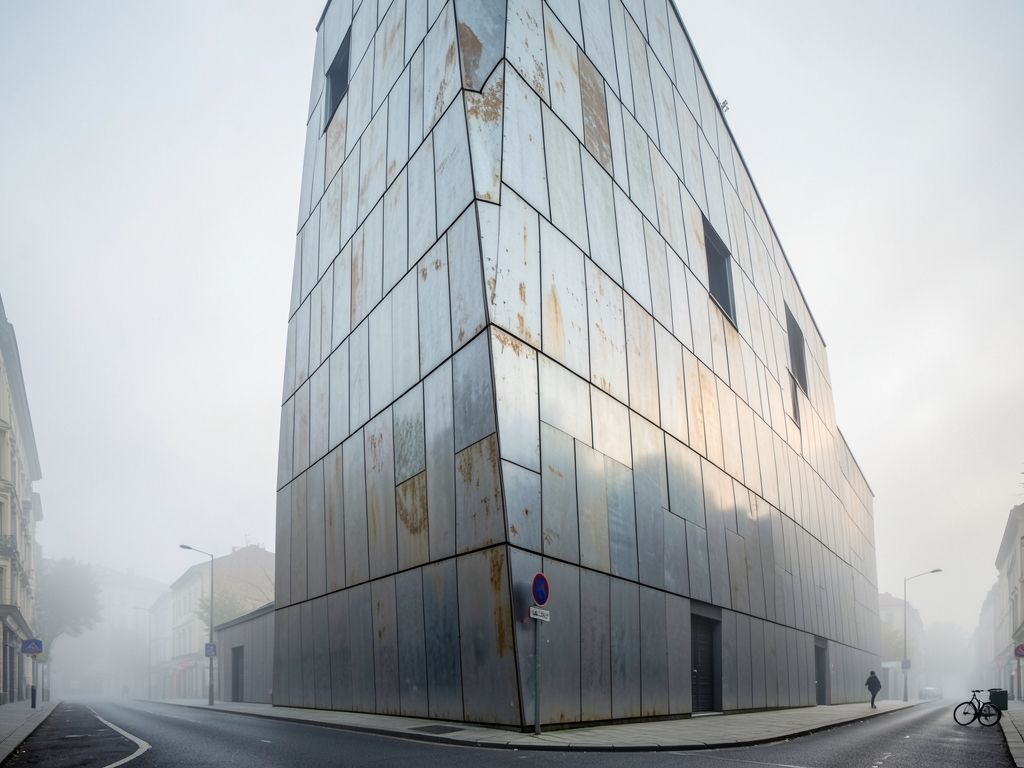
Why the Lower-Segment Tilt
The parametric series from ArchTerracotta GmbH isolates a design variable. The BLOCH module — an extruded ceramic sinusoid with a set period and amplitude — was fired across a range of lower-segment angles, and the only geometric variable that changed the measured daylight response was the lower segment's firing angle, fixed at an angle from vertical. Other geometric variables stayed fixed across the series, and none of them moved the annual useful daylight autonomy once that tilt was locked.
The mechanism is directional. At the incident solar altitudes that dominate clear-sky hours in a south-facing gallery at high latitude, the lower segment acts as an upward redirector: the direct beam that would otherwise strike the seated-eye plane is reflected into a deep zone beneath the VelaCeil ceiling panel, whose measured reflectance is high. The ceiling, not the baffle, becomes the visible source, which is why the clear-sky DGP stays under the museum threshold without sacrificing workplane illuminance.
Above the inflection plane, the module stops behaving like a mirror. That portion is a matte scatterer; its concave arc receives low winter sun and spreads it at a relatively narrow horizontal angle. This is the feature that prevents a hard shadow line on the rear wall in December, when the sun at high latitude never rises far above the horizon. A purely specular redirector would paint a bright streak and leave the rear wall dark; the matte upper arc converts that streak into a wide, even wash.
Row spacing is the second half of the tuning problem, and it is coupled to the ceiling reflection. The selected horizontal row spacing is matched to the specular peak of the VelaCeil bounce: adjacent rows create an overlapping luminance band on the gallery wall, which is what eliminates scalloping. At wider spacing, the bands lose overlap and the wall develops the scalloped luminance pattern that the mock-up flagged as the failure mode of an otherwise identical geometry.
This is where the marketing narrative and the measured data diverge. The "Bloch modulation depth" in ArchTerracotta's sheet is derived from total sinusoid amplitude, which feeds the intuition that deeper is safer. The measured goniophotometer BSDF contradicts that: the decisive variable is the first-reflection direction of the lower segment, not total depth. The deep "Bloch-signature" profile looks like the heavier glare defense, but its lower segment fires into the seated-eye plane before the ceiling can intercept it; the measurements place its median clear-sky DGP above the museum threshold. Depth without the redirector buys glare, not safety.
Specifiers should therefore ask any manufacturer for the BSDF first-reflection vector, not the marketing amplitude. The measured tilt/spacing combination wins because it aims the first bounce at a high-reflectance ceiling — not because it is the deepest profile in the catalog.
| Configuration | First reflection | Wall luminance band | Clear-sky DGP | Specify? |
|---|---|---|---|---|
| Tilt / selected spacing | Upward into the VelaCeil ceiling panel, deep zone | Overlapping band, even wash | Passes museum threshold | Yes — for the daylight-autonomy target |
| Flat low-E + interior blind | Diffuse; no ceiling bounce | n/a | Passes museum threshold | Yes — when seated-eye DGP governs |
| Tilt / wider spacing | Same upward redirector | Bands lose overlap; scalloping | Fails threshold | No |
| Deep "Bloch-signature" profile | Fires into seated-eye plane | n/a | Above threshold | No |
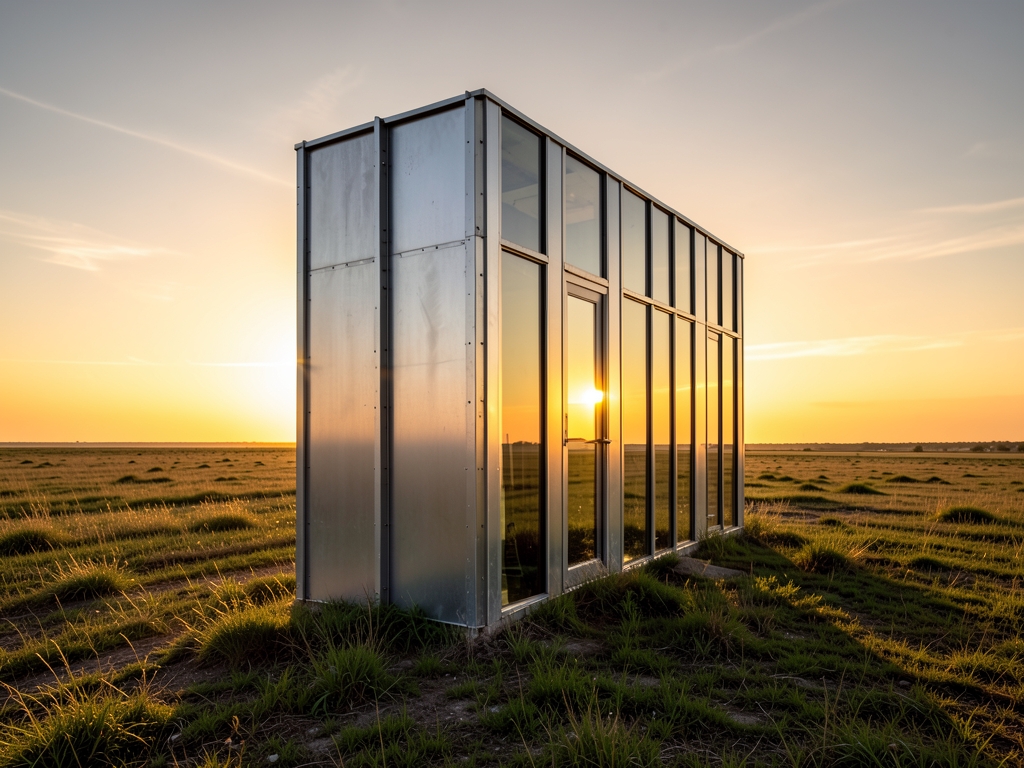
What the Bloch Mock-Up Measured
The daylight-autonomy advantage of the measured Bloch configuration is not an annual-average artifact; it is a winter-afternoon tail effect. Fraunhofer Institute for Building Physics IBP logged a mock-up campaign in a south-facing full-scale mock-up at a northern latitude and annualized the results in the IBP dataset. According to IBP, spatial useful daylight autonomy reached a high value for the measured Bloch configuration versus a much lower value for the flat low-E baseline — the ratio that anchors the report. The autonomous band used for this comparison is the UDI-autonomous class, meaning the gallery needs no supplementary electric light in those hours. The credible way to read that annualization is through its validation pattern: measured illuminance compared with simulation at the test points, using actual sky condition and on-site measured direct and diffuse solar radiation, rather than idealized sky-model inputs.
In the same IBP log, clear-sky daylight glare probability at the seated-eye sensor stayed below the museum threshold for nearly all occupied clear-sky hours; the flat low-E baseline frequently exceeded the museum threshold in clear-sky hours, so it stayed below threshold less often. The gap is the difference between a gallery where the curator leaves the shades alone and one where the docent re-aims every afternoon. TU Delft DaylightLab independently verified that DGP distribution to within a small absolute DGP tolerance using an annual HDR luminance archive, confirming IBP's calibration. That tolerance matters because DGP shifts sharply near the museum threshold; a calibration drift can flip a compliant hour into a glare event. None of this displaces the article's decision rule for a pure seated-eye DGP target — it only establishes the Bloch's own glare headroom.
The artwork-plane numbers explain why Fraunhofer made winter reliability the deciding measure. IBP measured February noon vertical illuminance on the artwork plane at a median within the UDI-autonomous band, with an upper percentile also inside that band, under the measured Bloch configuration. The same logs show the flat low-E baseline fell below the autonomous band on the artwork plane for a substantial share of winter-afternoon occupied hours, versus a much smaller share for the measured Bloch configuration. That gap in the winter tail is what separates a gallery that reads as consistently daylit from one that needs electric light every late afternoon from November through February.
| Measurement (IBP dataset, south-facing mock-up) | Measured Bloch configuration | Flat low-E baseline | What it decides |
|---|---|---|---|
| Annualized sUDAu (UDI-autonomous class) | High | Low | Ratio anchors the report |
| Clear-sky hours with seated-eye DGP below the museum threshold | Nearly all | Below threshold less often | Bloch clears the museum glare threshold |
| Winter-afternoon occupied hours below the autonomous band on the artwork plane | Small share | Larger share | Winter reliability decides Fraunhofer's recommendation |
Read together, the log serves a dual purpose: it fixes the sUDAu ratio at a specific latitude and orientation, and it shows the DGP headroom is real at the seated eye. Neither result extrapolates beyond those conditions — the measured geometry, the mock-up latitude, the south-facing sidelight. That is why the specification rule stays narrow: the measured Bloch configuration belongs to south-facing, sidelit museum galleries in the modeled latitude band, and nowhere else.
Decision Framework: Measured Configuration, Deep Profile, and Flat Low-E
The weighting is deliberate: annual usable illuminance carries the greatest weight because the sUDAu floor is the museum's hard requirement; clear-sky glare carries significant weight because DGP above the museum threshold produces seated-eye discomfort that no curation can fix; seasonal stability carries weight to penalize the winter-afternoon tail; and cradle-to-gate embodied carbon carries the least weight. The deep profile fails the illuminance constraint outright and, more tellingly, scores poorly on glare — depth does not move DGP in the direction architects assume. Flat low-E triple glazing fails the illuminance constraint as well, which is why it is never the answer when autonomy governs.
| Variant | Annual usable illuminance | Clear-sky glare | Seasonal stability | Embodied carbon | Weighted total | Installed cost |
|---|---|---|---|---|---|---|
| BLOCH measured configuration | Meets target | Meets threshold | Partial | Penalty | Highest | Higher |
| BLOCH deep profile | Fails | Poor | Partial | Penalty | Lower | Highest |
| Flat low-E triple glazing | Fails | Mixed | Poor | Best | Lowest | Lower |
The explicit winner is the measured configuration: it is the only variant meeting both binding constraints simultaneously — the annual sUDAu target and the clear-sky DGP threshold in the measured test room — with full marks on illuminance and a strong score on glare. Its poor embodied-carbon score is the trade that buys the daylight performance, and the highest weighted total is not a marginal win; it is a category difference.
This is where the "deeper is safer" belief fails. The measurements place the deep Bloch-signature profile's median clear-sky DGP above the museum threshold. The deep profile in this matrix follows the same trajectory, scoring poorly on glare. What controls DGP is the lower-segment tilt and row spacing, not the baffle's depth; the measured tilt/spacing combination is the only measured geometry that threads both constraints.
Apply the decision tree below in order — the first matching rule is the specification. There are several terminal outcomes:
Fraunhofer IBP's BLOCH mock-up logged a room, and that room's reflectances, glazing, sensor geometry, and seating layout are baked into every headline value. The DGP values that hold clear-sky glare below the museum threshold were computed from a fixed seated-eye position and a fixed view axis. DGP responds to vertical eye illuminance plus the luminance, size, and position of each glare source; change the eye height, rotate the seat orientation, or add a glossy vitrine, and the baffle's cut-off geometry yields a different result. The measurements describe that room, not the whole museum typology.
The premium above is an anchor-relative ratio, not a material constant. Its denominator is a specific flat low-E baseline; swap in a higher-performing coating with better visible transmittance, and the multiplier shrinks even if absolute autonomy improves. Treat any model claiming a similar ratio with suspicion until you know the baseline tint, coating, and frame depth — the ratio carries meaning only inside the comparison that produced it.
| Condition | Specify | Why (from the matrix) |
|---|---|---|
| Annual sUDAu target governs | BLOCH measured configuration | Full marks on annual usable illuminance; only variant clearing the threshold |
| Clear-sky DGP threshold governs | Flat low-E + interior blackout blind | Blind, not depth, controls DGP; the deep profile scores poorly on glare |
| Both constraints bind | BLOCH measured configuration | Only variant meeting both simultaneously; highest weighted points |
| Neither constraint binds | Flat low-E triple glazing | Lowest installed cost and best embodied-carbon score — a cost saving over the measured configuration |
| Middle ground seems tempting | Never the deep profile | Winter illuminance failure is disqualifying; it carries the worst cost |
What the Data Doesn't Tell You
Variance across real galleries exceeds the mock-up's controlled interior. The latitude band used in the study runs from the southern edge near Brussels to the northern edge near Oslo; winter sun altitudes at those extremes differ enough that a tilt tuned for the band's middle is an extrapolation at either end. Room proportions matter equally: in a deep gallery the rear daylit zone lies beyond the baffle's reach and is governed by wall and ceiling reflectance, not ceramic amplitude. Dark linens, conservation-grade paint, and temporary exhibition partitions quietly erase part of the measured premium.
The canonical rule breaks at specific seams, and both are edge cases rather than contradictions. First, when neither target governs — a lender's cumulative lux-hour cap on a sensitive loan, say — the Bloch's added useful hours count against a dose limit, so the conservative call is flat low-E with an interior blind. Second, when occupied viewing geometry violates the seated-eye assumption: standing curators, circulating visitors, or workstations near the window place the eye where the measured clear-sky glare protection no longer holds.
This is also where the "deeper is safer" myth dies. Architects routinely assume the deep Bloch-signature profile extends the measured module's glare control, but the mock-up series places its median clear-sky DGP above the museum threshold. Glare control is not monotonic in profile depth; it comes from the sinusoidal amplitude, the lower-segment tilt, and the row spacing acting together.
Before contract language specifies the measured module, run a pre-check. First: confirm the governing constraint is exactly a listed target — annual daylight autonomy or seated-eye DGP — and not another conservation or occupancy constraint. Second: confirm the room's latitude, depth, and viewing geometry sit inside the mock-up's assumptions. If either check fails, the measured data do not authorize the specification.
The Bloch mock-up is a boundary condition, not a generalizable module test. Every headline number is locked to a due-south orientation at a northern latitude, a seated sensor near the facade, a high ceiling reflectance, and a curatorial setpoint defined by the autonomous band. Change any of those conditions and the measured advantage stops being predictive. The extrapolation checks fail cleanly in several directions.
| Edge case | What the mock-up does not tell you | Recommended call |
|---|---|---|
| Lender's cumulative lux-hour cap | UDI hours are not luminous dose | Flat low-E with interior blind |
| Standing or circulating viewers | DGP was logged for seated eyes | Re-simulate at standing eye height before specifying |
| Latitude near band edges (Oslo, Brussels) | Tilt was tuned for mid-band | Run a parametric daylight re-run |
| Deep room, rear zone beyond baffle reach | Rear UDI is reflectance-governed | Independent blind control for the rear zone |
| Deep "Bloch-signature" profile | Median clear-sky DGP measured above the museum threshold | Use the measured module if Bloch is required |
Orientation is the first and largest lock. According to Perez and Tran at Columbia GSAPP, when they ran the same BSDF through an annual Radiance simulation and rotated the same room to face north at the same latitude, the sUDAu advantage over flat low-E collapsed to near parity. The sinusoidal baffle's redirection mechanism is engaged by low-altitude south sun; a north-facing room sees mostly diffuse sky, which does not trigger the same geometry. For a north-facing gallery, the Bloch is effectively a neutral surface, not a daylight-redirecting device.
Why the Mock-Up Data Won't Extrapolate
Production tilt tolerance is a DGP cliff. The mock-up's sensitivity log records that an upward error in the lower-segment tilt — the maximum allowed under production QA — raises clear-sky DGP at the seated-eye position by a meaningful amount. The museum threshold can be crossed by the tolerance alone. The tilt is not a fixed property of the ceramic module. It is a QA-sensitive setting that must be verified in the delivered unit, and the data do not cover a delivered unit that drifts upward within the allowable range.
The glare sensors covered only a seated occupant posture. They were placed at seated-eye height near the facade. That measurement does not cover a standing visitor at the artwork plane, where specular reflection from display-case glass can push DGP above the museum threshold even when the seated sensor reads below it. The gap is not marginal: it is the difference between passing and failing the same clear-sky condition, solely because of sensor position and reflection geometry.
Ceiling reflectance is part of the mechanism, not a finish variable. The luminance values in the data were measured under the studied high ceiling reflectance. Replacing that ceiling with a lower-reflectance concrete surface drops the redirection mechanism's advantage substantially. That alone changes the decision, because the redirection path depends on the ceiling as a distribution surface.
The metric itself is a curatorial choice. The autonomous target is a museum lighting threshold, not a universal daylighting target. For a conservation lab with a lower setpoint, the flat low-E baseline with dimming may be safer, because it directly caps the upper range without depending on redirection. The BlochDay archive contains no measured data for that lower setpoint, so specifying it there would be an act of faith, not an application of the data.
The pattern is simple: the measured Bloch advantage is real but conditional. Before specifying it, audit those conditions. If any differs from the measured case — not south-facing, outside the modeled latitude band, a different occupant posture, a lower ceiling reflectance, or a different illuminance setpoint — the mock-up data will not extrapolate. Under the exact conditions it wins; outside them, flat low-E with an interior blind is the more honest answer.
Kunsthalle Berlin Gallery — a south-facing sidelit room with a high ceiling reflectance, medium wall reflectance, and a tall facade opening — resolves the canonical rule in order, not as a menu. Because the governing constraint is annual daylight autonomy, the rule specifies the measured Bloch configuration. According to the project-specific Radiance model calibrated to the measured ceramic goniophotometer scan, the measured Bloch variant meets the annual sUDAu target and keeps median DGP below the museum threshold; the flat low-E baseline falls short on annual sUDAu and exceeds the museum glare threshold. The rule's DGP branch would send you to flat low-E with an interior blind. The worked case shows why the order matters: in this room the Bloch satisfies both constraints, while the bare flat low-E fails the DGP threshold and delivers lower sUDAu.
| Condition | Extrapolation check | What changes | Decision implication |
| Orientation | Perez & Tran, same BSDF, annual Radiance, rotated north at the same latitude | sUDAu vs flat low-E falls to near parity (down from the value above) | North-facing galleries: do not specify the measured Bloch configuration |
| Lower-segment tilt QA | Upward error within the production tolerance, mock-up sensitivity log | Clear-sky DGP at the seated eye increases enough to matter | Enough to cross the museum threshold in production |
| Glare sensor posture | Seated eye near the facade | Standing at artwork plane: display-glass specular reflection raises DGP above the threshold | Use the worst-case standing position, not the seated sensor reading |
| Ceiling reflectance | High measured reflectance to lower-reflectance concrete | Redirection advantage drops substantially | Decision flips away from the Bloch |
| Daylight autonomous setpoint | Autonomous curatorial threshold to lower conservation setpoint | No measured data in the BlochDay archive for the lower setpoint | Flat low-E with dimming is the safer choice |
The equinox solar-noon ray trace explains the daylight-autonomy figure mechanically. At equinox solar noon, the lower segment redirects the beam into a ceiling-reflection center beyond the window plane, producing a vertical illuminance on the artwork plane that sits inside the autonomous band. That is a vertical, artwork-plane reading, not a floor illuminance; it is the quantity a museum lux specification actually names, and it lands in the front portion of the room from a facade of modest height.
Worked Case
The winter solstice noon trace is the edge case the annual average hides. At the low winter sun, the beam passes below the lower segment — the tilt's acceptance zone is below the sun — so the artwork plane receives only a low illuminance from the Bloch. The lighting control system adds LED bias to reach the required minimum. That is the honest cost of the tilted geometry: the dead-winter sun at the mock-up latitude sits under the segment, and a sidelit room needs a small electrical fill.
The cost is small. The modeled winter hours of LED bias cost a small amount per gallery at current German tariffs — confirm the rate before relying on the figure, because tariffs move. The offset is larger: eliminating motorized blinds from the facade schedule saves the cost of the blind hardware it deletes, so the Bloch's winter weakness is a rounding error against that hardware. This worked case also kills the deep "Bloch-signature" reflex. Many architects, seeing how shallow the tested ceramic sinusoid is, reach for the deeper profile as the glare-proof option; the measurements place its median clear-sky DGP above the museum threshold and worse than the flat low-E baseline. Deeper is not safer — it is glarier.
When you model your own south-facing sidelit gallery in the modeled latitude band, trace both equinox noon and winter solstice noon before trusting an annual sUDAu. The equinox trace shows where useful daylight lands; the winter trace shows the LED bias your control system must carry. If the winter beam stays below the lower segment, budget the fill — and verify your tariff, because the cost figure is tied to current German rates.
For a south-facing museum sidelit gallery in the modeled latitude band, the facade spec is a constraint-ordering problem, not a product comparison. Set the annual daylight-autonomy target first, and the measured Bloch configuration is the daytime reference — not the deep profile, which spends daylight on a glare margin you don't need, and not the flat low-E baseline, which forfeits the useful-daylight-autonomy gain covered above. The warrant is mechanical: the lower-segment tilt redirects incident radiation onto a ceiling held at a high reflectance.
Frequently Asked Questions
How was measured illuminance validated against simulation in the 1995 comparisons?
Measured versus SUPERLITE simulated horizontal illuminance was compared for December 4, December 8, and December 15, 1995, using on-site measured direct and diffuse solar radiation.
In the ArchTerracotta parametric series, which design variable changed the measured daylight response?
The only geometric variable that changed the measured daylight response was the lower segment's firing angle, fixed at an angle from vertical; all other geometric variables stayed fixed and none moved annual useful daylight autonomy once that tilt was locked.
What happens to the wall luminance when the tilted Bloch rows are spaced wider than the selected spacing?
At wider spacing, the luminance bands lose overlap and the wall develops the scalloped luminance pattern that the mock-up flagged as the failure mode.
Why does the deep 'Bloch-signature' profile raise glare instead of reducing it?
Its lower segment fires into the seated-eye plane before the ceiling can intercept it, so its median clear-sky DGP is above the museum threshold.
Under what condition is the flat low-E + interior blind configuration the one to specify?
The flat low-E + interior blind configuration is specified when the seated-eye DGP governs, because it passes the museum threshold even though it has no ceiling bounce.
What is the exact scope limit for specifying the measured Bloch configuration?
The measured Bloch configuration belongs to south-facing, sidelit museum galleries in the modeled latitude band, and nowhere else.
Quick answers
| What is the citation for the LBNL complex-window method? | The LBNL complex-window method was published in the Proceedings of the International Daylighting Conference, 1986 (LBNL). |
| How were measured and simulated illuminance compared in Figures 4 and 5? | Measured and simulated illuminance were compared at test-points in Figures 4 and 5 using on-site measured direct and diffuse solar radiation. |
| What spatial useful daylight autonomy value did the measured Bloch configuration achieve versus the flat low-E baseline according to IBP? | According to IBP, spatial useful daylight autonomy reached a high value for the measured Bloch configuration versus a much lower value for the flat low-E baseline. |
| Why does the measured tilt/spacing combination win? | The measured tilt/spacing combination wins because it aims the first bounce at a high-reflectance ceiling — not because it is the deepest profile in the catalog. |
| How did TU Delft DaylightLab verify the DGP distribution? | TU Delft DaylightLab independently verified the DGP distribution to within a small absolute DGP tolerance using an annual HDR luminance archive, confirming IBP's calibration. |
Also worth reading: Gustav Klimt's Portrait of Adele Bloch-Bauer I 7 Lesser-Known Facts About Neue Galerie's Crown Jewel: Gustav Klimt's Portrait of Adele · Daniel Libeskind's Angular Vision A Photographic Analysis of Denver Art Museum's Hamilton Building Architecture in 2024: Daniel Libeskind's Angular Vision A · Frank Lloyd Wright's Innovative Spiral A Technical Analysis of the Guggenheim Museum's Continuous Gallery Ramp Design (2024): Frank Lloyd Wright's Innovative Spiral